
Every business model begins by identifying the firm’s target customer segment, who are considered potential buyers of its products, and share the following similarities:
- Interest preferences: i.e., like and dislike things.
- Demographic profiles: e.g., age, gender, socio-economic, profession, or education.
- Value preferences: i.e., value propositions that customers want to gain.
- Behaviours: i.e., buying processes of new products and their influences.
- Attitudes: i.e., how people perceive value.
- Incentives: physiological needs, safety, friends and family, self-esteem, and self-actualization.
- Demotivators: designs, channels, price, functions, features, size, etc.
The rationale beyond identifying customer segments at earlier stages of the business is to enable you to make offerings customers want. For example, the customer segment targeted by Swatch watches, a Swiss-origin brand founded in 1983, is upper-middle class youth of all genders, aged between 15 and 35 years old, who prefer fashionable design, trendy, sporty, highly effective cost watches. Customers may exist or not within a market, and innovators will design disruptive products to satisfy the unmet needs of the non-existing customers. Innovators may also target existing customers by making incremental innovations (e.g., improvements in features or functions on existing products) to better satisfy their needs. In turn, innovators serving existing customers have found it easy and less risky than the case of non-existing customers. As a result, segmenting markets will depend on the type of innovation (e.g., disruptive or incremental innovation) you intend to develop.
Creating a new customer segment
Here is a brief description of the blue-ocean steps for creating a market as suggested by (Kim and Mauborgne, 2005)1:
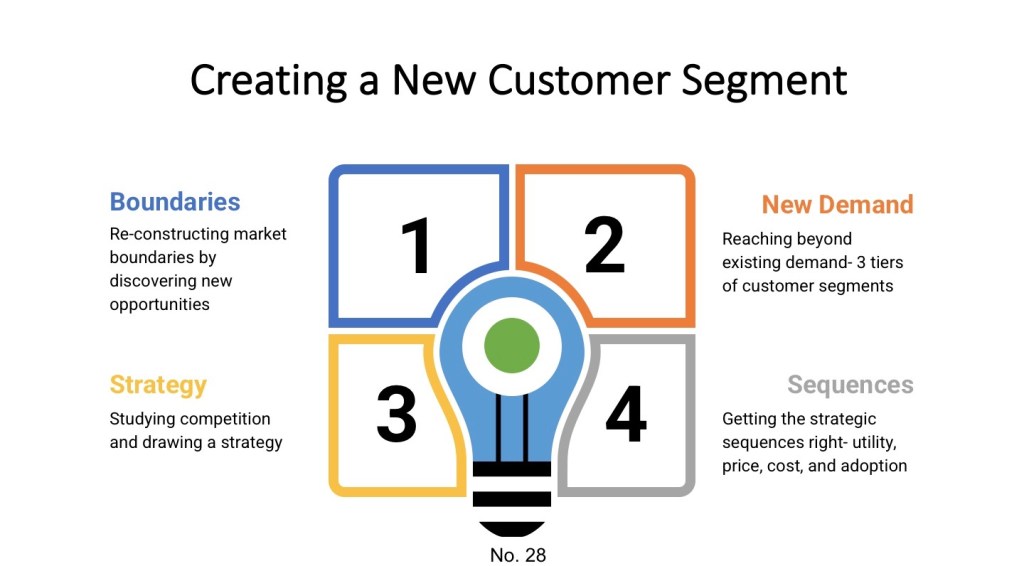
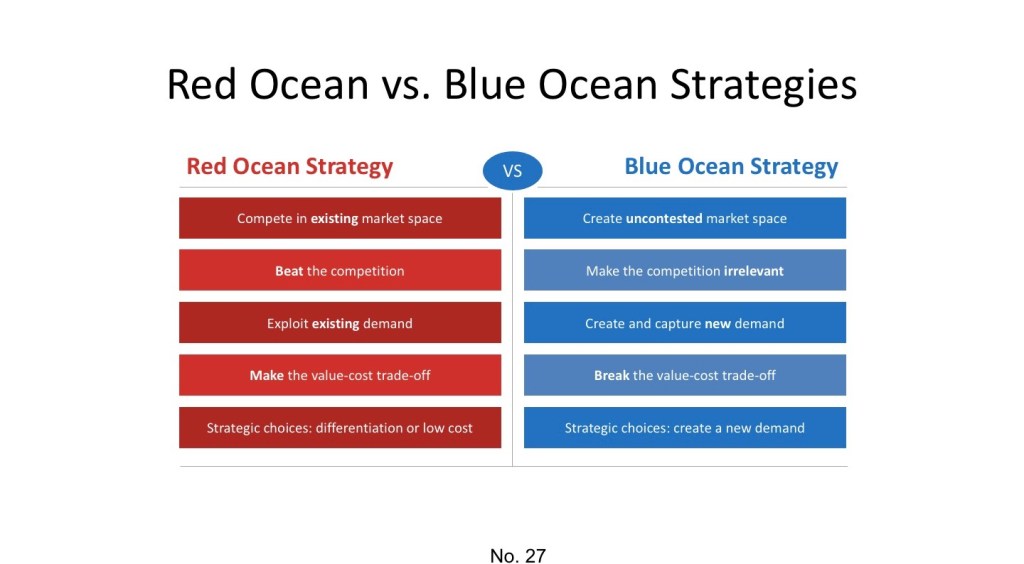
Step 1- Consider the blue-ocean principles
Blue oceans denote all the industries not in existence today and unknown market spaces. Blue oceans reveal untapped market space, demand creation, and opportunities discovering for profitable growth. Most blue oceans are created from within red oceans by expanding existing industry boundaries. In blue oceans, competition is irrelevant because the game rules are unknown. On the contrary, red oceans deal with the existing market, the competition rules are known to all players, and differentiation strategies may exist to protect competitors’ market shares.
Step 2- Reconstruct the market boundaries
- Path 1: Look across alternative industries: alternatives include products or services with different functions and forms but the same purpose. For example, consider cinemas versus restaurants. The space between alternative industries provides opportunities for value innovation.
- Path 2: Look across strategic groups within Industries: the term refers to a group of companies within an industry that pursue a similar strategy. Most companies focus on improving their competitive position within a strategic group. For example, Mercedes, BMW, and Jaguar focus on out-competing one another in the luxury car segment as economy car makers focus on excelling over one another in their strategic group. The key to creating a blue ocean across existing strategic groups is to break out of this narrow tunnel vision by understanding which factors determine customers’ decisions to trade up or down from one group to another.
- Path 3: Look across the chain of buyers: the purchasers who pay for the product or service may differ from the actual users, and sometimes, there are important influencers. Although these groups of purchasers, users, and influencers may overlap, they often differ. When they do, they frequently hold different definitions of value. By looking across buyer groups, companies can gain new insights into how to redesign their value curves to focus on a previously overlooked set of buyers.
- Path 4: Look across complementary product and service offerings: take movie theatres, the ease and cost of getting a babysitter and parking the car affect the perceived value of going to the movies. Yet these complementary services are beyond the bounds of the movie theatre industry as it has been traditionally defined. Untapped value hides in complementary products and services. The key is to define the total solution buyers seek when they choose a product or service.
- Path 5: Look across functional or emotional appeal to buyers: some industries compete principally on price and function; their appeal is professional. Other industries compete in feelings; their appeal is emotional. When companies challenge the functional-emotional orientation of their industry, they often find new market space.
- Path 6: Look across time: industries are subject to external trends that affect their businesses over time. Think of the rapid rise of the Internet or the global movement toward protecting the environment. Looking at these trends with the right perspectives can show you how to create blue ocean opportunities. By looking across time—from the value a market delivers today and might deliver in the future— managers can actively shape their future and lay claim to a new blue ocean. We’re not talking about predicting the future, but rather, we’re talking about finding insight into trends that are observable today.
Step 3- Reach beyond existing demand
To reach beyond existing demand, think of noncustomers before customers; commonalities before differences; and de-segmentation before pursuing finer segmentation. The three tiers of noncustomers include:
- The first tier of noncustomers: is closest to your market. They sit on the edge of the market. They are buyers who minimally purchase an industry’s offering out of necessity but are mentally noncustomers of the industry. In the fast food industry, for instance, these first-tier noncustomers were in search of better solutions.
- The second tier of noncustomers: is people who refuse to use your industry’s offerings. Consider, for instance, customers who refuse to buy a product because of health or quality or environmental or cost reasons.
- The third tier of noncustomers: is far from your market. They are noncustomers who have never thought of your market’s offerings as an option. Consider, for instance, the case of Procter and Gamble when first introduced baby diapers in China in the seventies, which faced significant hurdles to enter the Chinese market.
Step 4- Draw your strategy
After identifying the problem, solution, and customer segments to create a new market, it will be time to review the value offerings of competitors and draw a business model to create, deliver, and capture values. The business model canvas is the right tool to guide your drawing on a blue ocean strategy for your project. The business model canvas comprises nine business blocks: customer segment, value proposition, channel, customer relationship, revenue streams, partnership, activities, resources, and cost structure.
Step 5- Get the strategic sequence right
Then, identify the critical sequences of buyers, including utility (or value), price, cost, and adoption plan.
- Buyer utility- value proposition: is there any exceptional buyer utility in your business idea or products? Is there any compelling reason for users to buy your product?
- Price: is your price easily accessible to buyers? Is the price competitive enough to make a massive demand?
- Cost: can you attain your cost target to profit at your strategic price? What is your cost structure, and how it supports your blue-ocean strategy?
- Adoption: what are the adoption hurdles in actualising your business idea? Are you addressing them up front? What is the path of adoption of your products?
Selecting an existing customer segment
Contrary to disruptive innovation, incremental innovators deal with existing markets as they re-invent existing products with improvements in features, function, specification, or offerings. Choosing the right customer segment for your sustainable innovations involves segmenting the target existing market based on the following factors:
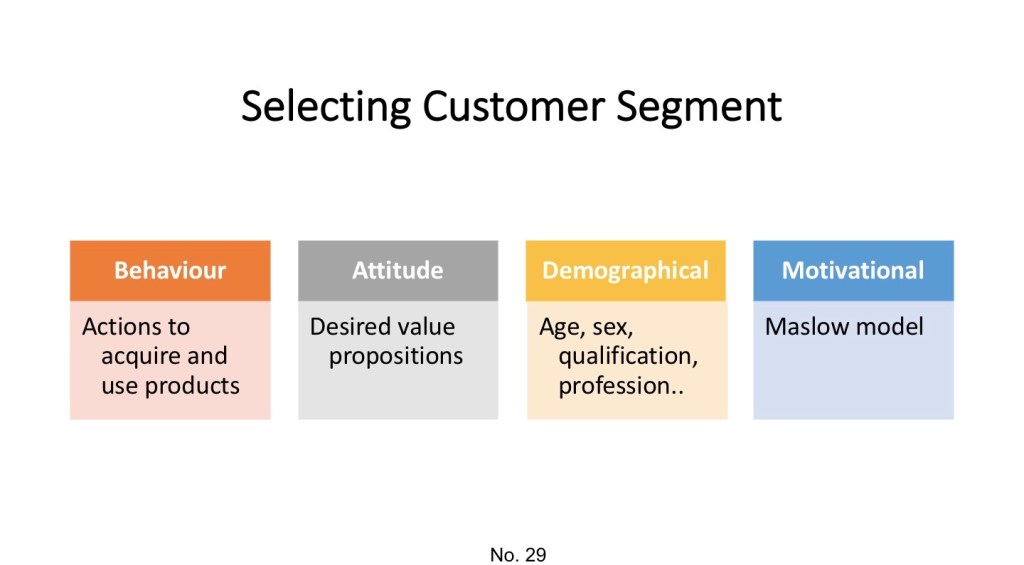
- Motivational segmentation: is when you use the Maslow model, proposed by American Abraham Maslow in his 1943 paper “A Theory of Human Motivation” in the journal Psychological Review, to classify people based on five motivational criteria comprising from the bottom to the top physiological needs (e.g., food, shelter, water, sex, clothing, and so on), security and safety needs (e.g., job security), love and belonging needs (e.g., friendship), esteem needs (e.g., recognition, financial and non-financial rewards), and self-actualisation needs (e.g., contribute as a volunteer). To reflect, this model explains people’s behaviours on, for instance, how to buy a product or service, in relevance to their psychological needs. For example, the hunger feeling pushes someone to buy food or eat.
- Demographical segmentation: is about dividing the target market into customer segments with common characteristics like age, gender, socioeconomic class, profession, education background and so forth. For example, a company identifies its target customer segment by location, gender, age, education, or income.
- Value segmentation: is about segregating the market on the need of the product’s value proposition. For example, a customer segment will set the required specification and features of computers as the size, weight, speed, or memory to buy.
- Behaviour segmentation: when you segregate customers on their buying processes, buyers will act to influence and buy a product or service.
The typical characteristics of an attractive customer segment include easy communication and reaching out, being large enough to create sufficient demand, having the potential to grow, and being financially capable.
- This post is sourced from my new book- Your Guide To Reach Innovation.
- For more information about the book: https://growenterprise.co.uk/your-guide-to-reach-innovation/
- To register in our newsletter: http://eepurl.com/ggcC29
Final note: the book- Your Guide To Reach Innovation, is an actionable guide to innovation from beginning to end. Enjoy reading the book, and I look forward to your reviews.
Author: Munther Al Dawood
maldawood@growenterprise.co.uk
References:
- Chan Kim, W., and Mauborgne, R., 2005. Blue ocean strategy, Harvard business school press, Boston, Massachusetts.

