
In today’s global competition, disciplined culture becomes a competitive advantage to many corporates, behaving teams and encouraging their aspiration for innovation. In this article, I explain the strong relationship between corporate culture and innovation and the factors influencing the culture to enhance innovation.
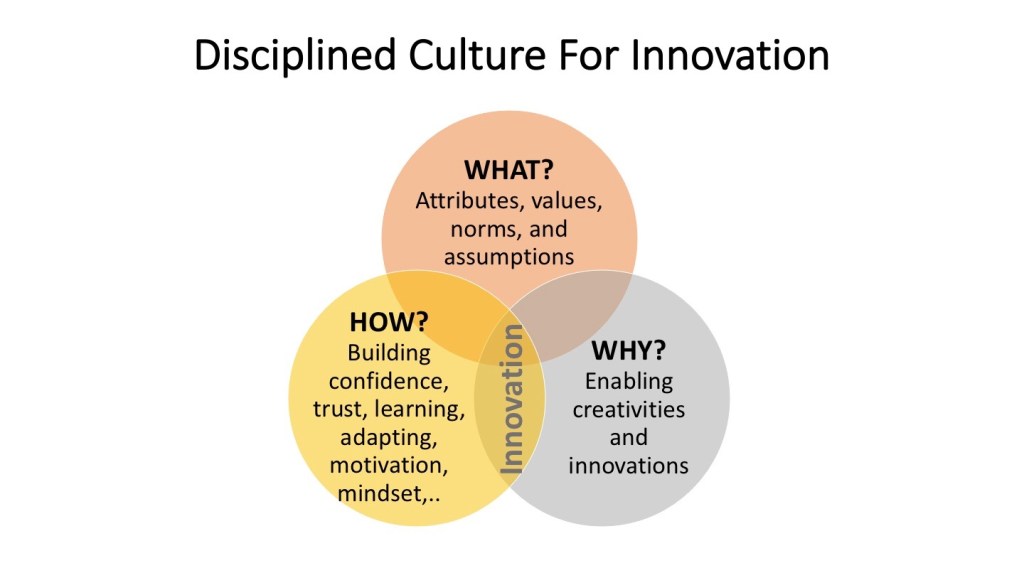
What is disciplined culture?
Corporate culture is a set of values and norms exercised by a group of individuals in an organization. These values are often implied and affect the ways employees behave and think in dealing with each other as teams and with outsiders. Company owners usually influence the corporate cultures built over time through employee contributions. Innovation culture is how people work together to create and use new ideas. Culture is the sum of values, beliefs, assumptions and behaviours of human groups. These traditions, norms and attitudes distinguish one group from another and shape the ways people create, think and solve problems (Max McKeown, 2016)1. What would the ideal company culture look like? Employees should love their work (Thiel, 2014)2.
One of the most distinguished thinkers and academics in the organisational culture is Edgar Henry Schein, a professor at MIT. Schein defines corporate culture as: “The pattern of basic assumptions that a group has invented, discovered, or developed in learning to cope with its problems of external adaption and internal integration, and that has worked well enough to be valid, and therefore, to be taught to new members as the correct way they perceive, think, and feel about these problems” (Schein 1985)3. Schein described the corporate culture at three levels:
- At the first level are organisational attributes that public observers can see, feel, and hear, and include stories that are told about the organisation’s history, rituals, or ceremonies.
- The next level deals with the values (e.g., we value punctuality) and norms (e.g., one should not be late) of an organisation. Values and norms can be seen in a company’s policies and procedures manuals, recruiting and onboarding processes, performance management (appraisal and reward) systems, promotion guidelines, and patterns about which rules to follow or ignore. In essence, the professed culture comprises visible expressions of “what we value around here.”
- In the third and deepest level of corporate culture are the organisation’s tacit assumptions. These are the elements of culture that are not observable in everyday work. Some of these may be elements of culture that are taboo to discuss. Many of these unwritten rules exist without the conscious knowledge of the organization’s members. Those with sufficient experience to understand this deepest level of organisational culture usually become acclimatised to its attributes.
Why is discipline culture important to innovation?
There are many reasons for building a disciplined culture to reach innovation, and here are some reasons for that:
- The innovation cycle begins by observing, understanding issues and ideating, and these processes are not often enforced by the corporate system but rather encouraged by the corporate culture.
- Innovation by definition is practical creativity; thus, discipline culture can encourage creativities among employees by spreading the values and norms of initiation, proactiveness, and creativity to improve the way teams work and outcomes.
- Teams looking for innovation will need a certain level of motivation, leadership, accountability and protection against the risk of fear of failure. Some of these requirements are governed by management policies; however, implicit rules, like disciplined culture, governing these innovation activities are much more powerful and influential than formal rules.
- There are strong ties between discipline cultures and leadership in organizations, where one of the key duties of any leader is enriching the culture and enabling innovation.
- As disciplined culture deals with attributes, values, norms and assumptions on how employees work and collaborate with stakeholders, this helps to encourage team working and generate ideas for better processes, products, and offers to the market.
- Culture with disciplines reduces the burdens of controlling employees and losses, motivating teams to innovate freely without any fear of failure and management pressure.
Tips for building an innovation culture
Here are some tips showing the factors influencing innovation culture:
- Culture guidelines: If you want your team to innovate routinely, you need to nurture a creative culture. Here are five guidelines that can improve your innovation culture (Kelley and Kelly, 2013)4: (1) keep your sense of humour, (2) build on the energy of others, (3) minimize hierarchy, (4) value team relationships and trust, and (5) surround yourself with like-minded innovators.
- Creative confidence: What does it mean to have a culture that fosters innovation? The biggest cultural barriers to innovation are the fears of personal failure and career setbacks. Only by regaining a degree of creative confidence can these individuals see failure as an important way to learn, allowing them to take on the kinds of challenges that lead to breakthroughs (Power, 20140)5.
- Getting people to do what they love: Innovation is about extending what is possible. Leading innovation involves inspiring people to see and want better futures, work, and processes. Getting people to do what they love the most is an effective way of inspiring creativity and commitment to a better future (Phillips, J., and Phillips, P., 2018)6.
- Organizational culture: Can be powerful in complementing a company’s formal structure and reducing the need for extensive, complex hierarchies and processes (Feser, C. 2012)7. Culture, for instance, can help guide the daily activities of employees and their decision-making, enables greater decentralisation of power, and provides general guidance but leaves the specific way how up to the individual, allowing more space for adaptation at the front line. In doing so, culture replaces detailed processes and job descriptions.
- Learning and adaption: a good culture contains elements that foster learning and adaptation, and that facilitate change. A culture that embodies flexibility and openness to new ideas and styles sets the stage for a change-oriented organisation and helps employees cope with the tensions associated with change (Recardo, Molloy, and Pellegrino 1995)8.
- Empowering innovation mindset: A company that looks for managing innovations should build creative and enabling-mindset culture. To harvest the power of design thinking, individuals, teams, and whole organisations have to cultivate optimism. People have to believe that it is within their power (or at least the power of their team) to create new ideas that will serve unmet needs and have a positive impact (Brown, 2009)9.
- Enabling philosophies of the lean start-ups: Such philosophies include being a learning organization (e.g., problem-solving, ideating, experimenting, and testing), killing the silos (e.g., the conventional method of reducing cost is running volume of scale, but the new approach is encouraging innovation to reduce costs), customer development instead of product development, applying objective thinking in solving problems instead of blaming individuals.
In summary, innovation processes encompass inspiration, understanding, ideating, and implementation, and these activities require a creative mindset to develop new ideas, risk-taking, think openly with no fear of failure or blaming, and work as a team collaboratively. Leaders can build up an innovation culture by crafting a creative mission and vision, setting it a management operating system, leading talented teams, and activating communication to encourage teamwork and collaboration. Thus, innovation culture is considered a must-have environment in every company to manage innovation.
- This post is sourced from my new book- Your Guide To Reach Innovation.
- For more information about the book: https://growenterprise.co.uk/your-guide-to-reach-innovation/
- To register in our newsletter: http://eepurl.com/ggcC29
Final note: the book- Your Guide To Reach Innovation, is an actionable guide to innovation from beginning to end. Enjoy reading the book, and I look forward to your reviews.
Author: Munther Al Dawood
maldawood@growenterprise.co.uk
Reference:
- Max Mckeown, 2016. The innovation book, Pearson, UK.
- Thiel, P., 2014. Zero to one, Crown Business, New York.
- Schein, Edgar, 1985. Organizational Culture and Leadership, the University of Illinois at Urbana-Champaign’s Academy for Entrepreneurial Leadership Historical Research Reference in Entrepreneurship.
- Kelley, T. and Kelly D., 2013. Creative confidence, Crown Business, New York.
- Power, D., 2014. The curve ahead, Palgrave Macmillan, USA.
- Phillips, J., and Phillips, P., 2018. The value of innovation, Wiley, NJ USA.
- Feser, C. 2012. Serial innovators, Wiley, NJ USA.
- Recardo, R., Molloy, K. and Pellegrino, J., 1995. How the learning organization manages change, National Productivity Review, Winter 1995.
- Brown, T., 2009. Change by design, HarperCollins e-books.
 Grow Enterprise