
In today’s open innovation business, corporate leadership and teams are the most critical inputs to any innovation initiative. Leadership is a powerful capability, especially in initiating innovation projects and leading teams to aspire to innovation. Organizing teams for innovation requires special considerations regarding roles, skills, and duties. In this article, I tackle the factors influencing leadership and teamwork in managing innovations.
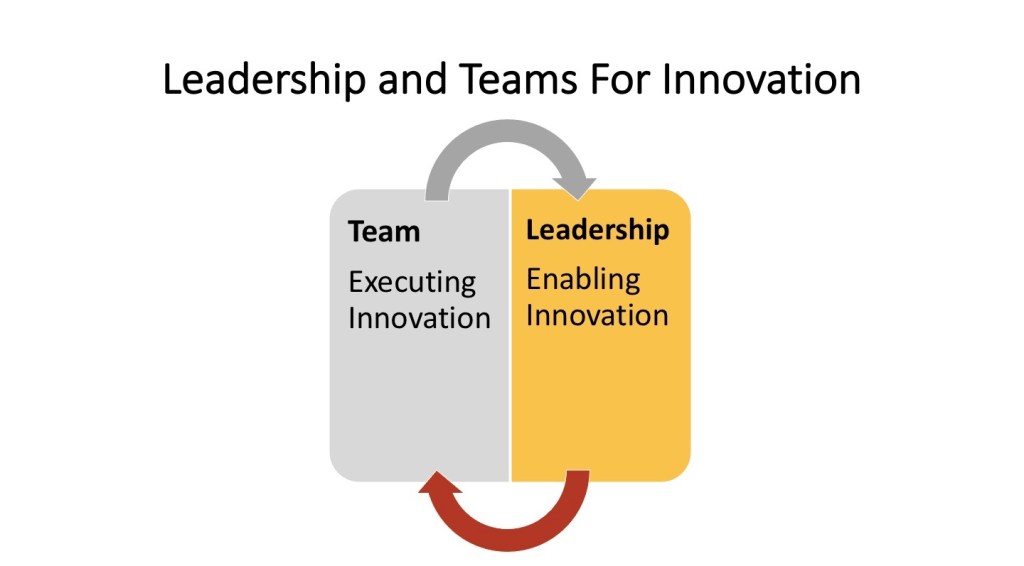
Why is leadership substantial to innovation?
Innovation leadership is a philosophy and approach that influences teams to invent ideas and products. The two fundamental leadership theories necessary for innovation are: the Path-Goal and Leader-Member Exchange.
- Path-goal theory is a leadership approach developed by Robert House in 1971 and revised in 1996. The theory states that leaders’ behaviours are contingent on the satisfaction, motivation, and performance of their subordinates.
- The leader-member exchange theory is a relationship-based approach to leadership that focuses on the two-way (dyadic) relationship between leaders and followers.
The role of the leadership in organisations includes:
- Supporting activities: are including, (1) supporting idea generation, (2) identifying innovations, (3) evaluating innovations, and (4) implementation.
- Creating toolset: the collection of techniques used to perform duties, generate new options, implement them in the organisation, communicate direction, create alignment, and cause commitment.
- Developing skillset: a variety of abilities that allows innovation leaders to use their knowledge and capabilities to accomplish their goals.
- Building mindset: the collection of attitudes and behaviours that allow leaders and their subordinates to think differently and create divergent ideas for innovation. Mindset is the operating system of the creative thinker and distinguishes those leaders who enable creative thinking and innovation from those who do not.
- Enabling Good-to-Great abilities: this concept is developed by (Collins, 2001)1, identifying the leadership abilities as (1) level-5 leadership, (2) forming and leading the team, (3) maintaining unwavering faith in what they do, (4) focusing on the core abilities, (5) building a disciplined culture, (6) working hard within a vision, and (7) build values to last.
- Creating ‘Multiplier Leaders’: this concept is promoted by (Kelley and Kelly, 2013)2, creating the ‘multiplier leaders’, who can double the team’s outputs and improve morale by (1) attracting and retaining the best creative people and helping them reach their highest potential, (2) find a worthy challenge or mission that motivates people to stretch their thinking, (3) encourage spirited debate that allows and considers different views, and (4) give team members ownership of results and invest in their success.
- Enabling learning and decision-making: leaders create collaborative organizations, foster discovery-driven learning, and encourage integrated decision-making.
- Supporting the organizational capabilities: leaders develop organizational capabilities to create innovation that may include crafting a vision, drawing a strategy, managing teams, developing systems, enforcing a culture of disciplines, enabling innovation processes, resources, and more.
- Activating the ‘Leadership Rhythms’: the term ‘Leadership Rhythms’ is argued by Van de Ven, describing that leadership innovators perform multi roles, including (1) entrepreneurs who have high involvement, believe in the project and inspire others to get involved, (2) mentor offering advice, (3) sponsor providing investments in the project, (4) institutional leader setting the structure and context, and (5) critic- encourages deep thinking about alternatives and sequences.
How can teams be better organized for innovation?
Team in organizations is as important as leadership and other organizational inputs. Here, I explain the duties, skills, and roles of the innovation team, highlighting the importance and the role of teams in innovation.
Basic duties for the innovation team
Human resources are the main inputs to managing innovation. Talented, experienced and motivated teams are an asset to the organisation and essential to successful innovation. The skills, roles and duties of innovations vary from one organisation to another, and as a rule of thumb, the basic duties of the innovation team are:
- Set the innovation strategy and define success.
- Provide a framework for innovation.
- Communicate, inspire, and diffuse.
- Design thinking and implementing innovations.
- Measure innovation, and improve continually.
Basic skills for innovation teams
The innovation team must adhere to the basic skills required to manage innovations:
- Strategic thinking: is about thinking long-term with vision, choosing the fit positioning and direction forward, discovering promising opportunities, and setting objectives, action plans and resources to deliver innovations.
- Problem-solving: this is a skill for identifying problems, analysing root causes, and taking corrective and preventive actions.
- Customer development: is a variety of activities to discover, validate, and create customers. It’s a skill that every innovator must adhere to develop customers to newly created innovation projects.
- Creating and testing ideas: is a must skill for any entrepreneurs to spot opportunities, identify problems, craft solutions and prototypes, experiment, and implement to roll out a new product to the marketplace.
- Data collection and analysis: research is a vital tool for any innovator to discover opportunities, enhance knowledge, create prototype solutions, and experiment with them in the marketplace.
- Communication: is an essential skill for innovators, sending and receiving information about innovation projects.
- Project management: is a collective of skills, including initiation of the project, planning, executing, monitoring and control, and closing. Further, it involves some knowledgeable areas covering the scope of work, time management, quality, costing, risk, teamwork, communication, and procurement.
- Selling and business development: innovators creating values will need to sell them afterwards to the potential customer segments, making the skills of selling a must to have the capability for capturing and monetising values.
- Design thinking: is reintroduced by the IDEO organization, and includes five key stages to building innovation (1) observation of people, (2) understanding and identifying problems, (3) ideating and prototyping, (4) experimenting, (5) implementation rolling out innovations to the market.
- Creative thinking: is a must-adhere skill for anyone creating new ideas that can stand out from the crowd. It is about thinking differently than other people ideating new solutions for pressing issues, and improving the ways we do things.
- Leadership: is a collection of abilities, discovering opportunities and leading teams and other resources to capture values.
- Collaboration and team-working: innovation is a result of collaborative teamwork in organizations. No innovation is created without a team collaboration and diverging multi ideas to solve issues.
- Risk taker: innovations involve three levels of uncertainties, (1) environment uncertainty (e.g., unknown about the market), (2) value uncertainty (i.e., what are the value propositions most wanted by customers), and (3) agenda uncertainty (i.e., unsure what to do and how to prioritise tasks to make innovation or values)
- Finance: is a must skill for any innovator, covering innovation funding, cost structures, revenue streams, pricing, profitability, cash flows etc.
- Digital and technical knowledge: digital knowledge becomes necessary for any business, torching innovators to use digital tools to research, communicate and conduct businesses. Also, in every field of business, there should be an area of technical knowledge that innovators must learn to excel in improving operational efficiency.
- Product design and prototyping: ideating and value solutions are delivered through the product design and prototyping stages. Prototyping is the minimum visual concept about the value solution, easing the experimenting, testing, and communicating with market streams before transforming products.
- Passionate: is the key driver for delivering novel solutions to challenging problems
- Creative agility: is a term that reveals a quick reaction to the market, exercised in different situations like discovering opportunities, creating innovative solutions, experimenting, running businesses, and more.
Roles for innovation
Based on my experience searching the organisational structures of several leading firms working on innovation, here are some common roles of innovation:
- Chief innovation officer: is the face of innovation in a large organisation, defines the innovation strategy based on the overall corporate strategy and checks execution as planned. This person leads a team of innovation managers and new business development managers.
- Innovation consultant: is a technical expert and usually works on innovation projects and managing technical activities.
- Business development lead: guides and fuels company growth, shapes its sales strategy and develops new and existing business relationships. This person will pursue new business development activities and guide teams to do the same.
- Innovation catalyst: has expertise in cultural trends and insights and knows what it’s like to drive a global strategy to regional teams per continent. Their goal is to find consumer and innovation growth opportunities in emerging markets. The innovation catalyst’s strength is in uncovering what consumers are missing in their lives and creating new products or services to solve this. Some innovation catalysts work with internal stakeholders to collect ideas, problems, and opportunities from employees.
- Innovation analyst: uses research and data analysis to find changes/opportunities in the market. This person suggests business process improvements using analytics. Monitoring the activity of competitors is a key part of this role. This person’s goal is to manage the development of product requirements while aligning with the business strategy.
- Digital transformation manager: shows experience in digital strategy, communication, marketing, and product management; these digital experts handle the digitalisation of existing (or new) products and services. The digital transformation officer leads a team of digital natives to implement a chosen digital strategy.
- Venture builder: cofounds new businesses and helps get them off the ground. This role is tasked with challenging and speeding up innovative corporate ventures to ensure viability. The venture builder brainstorms business ideas, builds the right teams, leads innovation sprints, raises capital, and leverages shared resources.
- Product design prototype: has a hand in developing products from start to finish. The product development prototyper is involved with research, concept, design, etc, and must have skills (depending on the industry), including visual design capabilities and experience with related systems and programs.
- Customer experience researcher: selects problems/opportunities worth tackling and conducts customer validation, solution ideation, prototype testing, etc., to develop customer-centric business ideas from conception to launch. This person combines user research, usability, design, and various innovation method expertise to generate new disruptive products.
- Tech lab leads: researches and experiments with different innovation technology tools to design radical innovation processes.
- Strategists: they are strategic thinking and involved in planning the innovation transformation journey. Strategists possess extensive exposure to innovation programs and a deep understanding of the industry, the competitors, and the market dynamics, and come up with strategies that tackle creative projects.
- Product experts: they are supported by well-defined problems worth solving, business opportunities, innovation themes, and focus areas. This team must be able to ‘think of products’ and spot related opportunities in the market. They must develop a deep understanding of the competition and the global developments to identify gaps and opportunities that link up to commercial aspects of your business. The team must think as a user and identify how innovation can bring value impact.
- Technologists: These are experts combining deep technical knowledge, best practices, and understanding of product architecture, the product development lifecycle, and product innovation methodologies. They drive initiatives such as the transition to agile engineering practices and modern product development techniques focusing on experimentation and data-driven decision-making.
- Program Managers: demonstrate their specialisation in ‘making things happen’ – they drive programs, lead multiple initiatives, and manage projects to enable innovation transformation.
- IP experts: handle the intellectual-property protection of novel, high-potential and patentable solutions.
- Innovation Advocates: create and execute a communication plan that presents the organisation’s innovation program, along with the activities, outcomes, and especially the success stories of innovation. This effort must be led by passionate and effective communicators who diffuse innovation messages and communicate any progress made, achievements, top performers, and innovation stories.
- Innovation Specialists: educate the organisation regarding experimentation, idea management, design thinking, agile frameworks, and related methodologies and practices. They typically facilitate and drive workshops, ideation sessions, and the practical aspects of day-to-day innovation.
- Last, the ten personas of innovation: the ten faces of innovation are developed by (Kelley and Littman, 2005)3, grouping the organizational roles into three groups (1) learning roles that include the anthropologist, experimenter, and cross-pollinator, (2) organizing roles that include the hurdler, collaborator, and director, and (3) building roles that include experience architect, set designer, caregiver, and storyteller.
- This post is sourced from my new book- Your Guide To Reach Innovation.
- For more information about the book: https://growenterprise.co.uk/your-guide-to-reach-innovation/
- To register in our newsletter: http://eepurl.com/ggcC29
Final note: the book- Your Guide To Reach Innovation, is an actionable guide to innovation from beginning to end. Enjoy reading the book, and I look forward to your reviews.
Author: Munther Al Dawood
maldawood@growenterprise.co.uk
Reference:
- Collins, J. 2001. Good to great, Harper Business, USA.
- Kelley, T. and Kelly D., 2013. Creative confidence, Crown Business, New York.
- Kelley, T. and Littman, J., 2005. The ten faces of innovation, Random House.

