
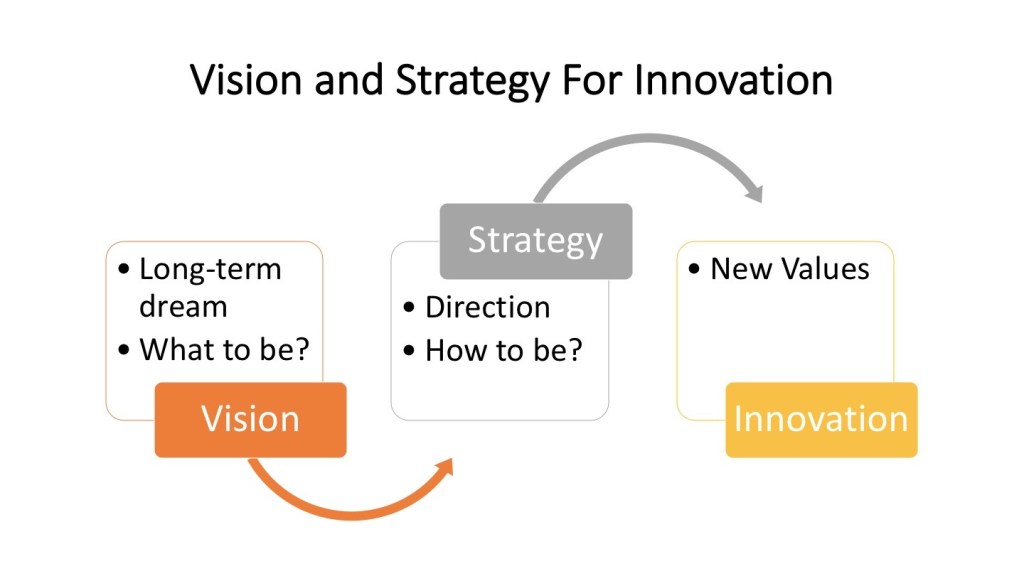
No one can make any innovation without having a creative vision and strategy. Vision is a long-term dream about a business or product, whilst strategy identifies the best ways to implement the vision. In this article, I discuss the importance of the vision and strategy elements in creating innovation and show steps to develop each of them.
What is vision, and how do you craft it?
Vision is a dream about how a business or product will be in the future, and it is the starting point for any corporate strategy, objectives, and metrics. Vision is a long journey that starts from where you are today to reach a better future. Three factors judge the significance of visions: (1) desirability, (2) challenge, and (3) belief. Vision is desirable if it brings new values to customers and is a challenging project as it involves, for instance, specific activities, resources and risks to make a significant change. Moreover, people or stakeholders must believe in the underlying vision to buy it. Internal forces influencing the subject of vision include resources, experiences, culture, and leadership, and the external forces involve technology trends, business change, social change, environmental factors, competition, and customer needs.
How can you encourage and inspire people to cope with perspective change and see challenges as opportunities for innovation? You start by looking at where the business is today and where it is heading in the future, then create a vision for your business. To build a business that can drive innovation through change, the leader has to start with a clear vision for everyone to aim for. Nothing is more important than communicating this ambitious dream and inspiring teams to contribute to achieving the big aspiration. Vision is perceived as an ambitious dream to make a success to the firm by envisioning a new product, process, business, or market. Vision is usually initiated and decided by the owner or leader of the project, then cascaded to workable strategies and business plans to achieve it. Undoubtedly, innovators require an ambitious vision to make victorious innovations. Ways to inspire visions involve group activities like inspiration, market and customer analysis, value mapping, industry analysis, technology searching, brainstorming, seeking expert advice, or SWOT analysis to discover opportunities.
Why is vision important to innovation?
Vision can bring many benefits to the organisation, including:
- Focusing staff and resources on a common goal.
- Aligning business plans for a specific strategic direction.
- Changing the current situation to a better future.
- Enforcing more control over staff work.
- Leading teams to be more creative and contributing to the company’s prosperity.
As an example of corporate vision, Ofgem’s innovation vision (2021-2025), the independent regulator for energy markets in the UK, is the transition to net zero – including the decarbonising of power, heat and transport – and the impact of democratisation, decentralisation and digitalisation will redefine and shape the energy landscape over the next 20 years. In this Vision, we set out innovation principles and priorities to highlight areas where Ofgem has identified the need for significant innovation and to encourage regulated parties and other innovators to innovate in these spaces (https://www.ofgem.gov.uk).
Here are some literature reviews on the importance of ‘vision’ to innovation:
- Most successful endeavours start with a big vision, projecting where you will be in five years, and it is about what drives your business to succeed and is the change to make. No matter whether you either start with the segment, problem, product, or technology, the vision is less about how you change and more about what you change (Cooper and Vlaskovits, 2013)1.
- The disruptive method comprises three components which are (1) convention (i.e., challenging the existing way of thinking, (2) vision (i.e., creating a new way of thinking for a brand or company to define its future), and (3) disruption (i.e., creating an idea that will speed up our journey from challenging convention to renewed vision (Jean-Mario, 2015)2.
- A good innovation process should be driven by the company’s three-year vision and revenue gap (Power, 2014)3.
- How well do we manage innovation? One of the essential criteria to use is for the top team to have a shared vision of how the company will develop through innovation (Joe and John, 2009)4.
- The essence of ‘Running Lean’ can be distilled into three steps: (1) document your plan, (2) identify the riskiest parts of your plan, and (3) systematically test your plan. The significant part of developing a plan is to create a vision or a mantra with facts, not faith, and you accept that your initial vision is built on untested assumptions (or hypotheses) (Maurya, 2012)5.
- Innovators will need to create a vision, strategy and product to build up an innovative start-up and then carry out iterative experiments to test the start-up strategy and products to see which parts are brilliant and which are crazy. This process begins with a clear hypothesis that makes predictions about what is supposed to happen and then tests those predictions empirically. Start-up experimentation to test assumptions is guided by the start-up vision. The goal of every start-up experiment is to discover how to build a sustainable business around that vision (Ries, 2011)6.
What is strategy, and how do you develop it?
Innovation strategy documents how the company plans and delivers projects in the coming three to five years and comprises objectives, initiatives, projects, actions plan, resources and key performance indicators. Strategy is usually developed by the business owners or top management, drawing the ways forward to tackle innovation projects.
The innovation strategy identifies five key elements: (1) value creation, (2) transactions, (3) resources, (4) value delivery, and (5) value capturing. Value creation reveals the core value propositions around the new products, and transactions are activities to make the strategy work. A strategy identifies resources like people, money, assets, and intangible assets needed to make the strategy work. In delivering values, innovators show how the values or products are communicated and distributed to target segments, and value capturing is selling and monetising values.
To create an innovation strategy, the team will begin by analysing the internal and external environments related to the innovation market and conclude some opportunities that match the company’s core abilities and competitive advantages. Originated opportunities are challenges or customer needs that need quick fixing. And they are derived from: (1) the desire to improve efficiency (e.g., reducing the product cost) or (2) increase customer experience (e.g., creating new or improved products or channels), or (3) develop breakthrough technology (e.g., R&D, knowledge, or technological product or application or platform).
The outcomes of this innovation strategy can be improved processes and products (i.e., improved features of existing products or services targeting low-end markets) or disruptive products (i.e., invented products or services targeting untapped markets and customers).
The company team creates and implements strategy, and thus it should be discussed and communicated across the company departments to enable teams to take part in executing it. Innovation strategy is executed by decomposing it into shorter terms, e.g., one year, called action or business plan, making it easier for the team to set reachable targets and day-to-day activities.
The progress of the innovation strategy is typically evaluated against the set objectives and key performance indicators taken from the industry benchmarking and best practices. Management puts in place a proper monitoring and control system to ensure alignment of activities and accuracy of execution toward meeting the strategic objectives.
Why is strategy important to innovation?
The importance of any strategy lies in the creative ways to implement the organization’s mission and vision. By doing this, innovators will focus staff and resources on a common goal, aligning business activities for a specific strategic direction, and enforcing control over performances. Besides, innovations often involve higher levels of uncertainty, making the process of innovation challenging and lacking clear direction; thus, the strategy will come to mitigate risks and identify the best ways forward to create innovation.
In innovation practices, there are two main approaches to building innovation strategy; the first, is the blue ocean strategy, and the second is the business model Canvas.
In a business-strategy context, you can imagine a market universe composed of two sorts of oceans, red and blue oceans; the red oceans, represent all the industries in existence today and known market spaces, whilst the blue oceans denote all the industries not in existence today and unknown market space (Kim and Mauborgne, 2005)7. Articulating a blue ocean strategy involves expanding the market boundaries to explore untapped opportunities, setting the strategic sequences right for the utilities (or values), cost, price, and adoption, and last, drawing a strategy to ease implementation and rolling out to the marketplace.
Osterwalder’s business model (Canvas) designed a strategy for growth comprising nine business blocks. This canvas model has become widely popular in the field of start-up growth and innovation and consists of nine business blocks (Osterwalder and Pigneur, 2010)8. These business blocks are customer segment, value proposition, channels, customer relationship, revenue streams, partnership, key activities, resources, and cost structure. For innovators making a business strategy, they will identify assumptions around these nine business blocks before testing them in the market and implementation.
There are many strategic options for innovation including (Peter Drucker, 1985)9:
- Dominating the market: focuses on market leadership or dominance and aims at creating something new and different. The strategy requires an analysis of internal and external influencers and crafting a strategic position. It is risky and creates new products targeting low-end markets.
- Creative imitation: is when innovators copy original innovation and represent it with better features or offerings. For example, IBM practised creative copying with a personal computer, which is the idea of Apple. Creative imitation neither brings innovation nor invents a new product; however, it may be a new feature of an existing product, or new distribution channel, or sold at reduced prices.
- Monopolising the market: aims at market or industry leadership and controlling the niche market.
- Changing values and characteristics: is a strategy when creating unique value to the customer, e.g., easy, quick and cheaper to get. Or when dominating the market by reducing the prices to be the lowest in the market, e.g., disposable shaving razors sold at competitive prices after decades of selling a fancy and expensive set of shaving. Or when a customer buys a product or service that fits his needs.
How do you measure the impact of vision and strategy on innovation?
There are many ways to measure the impact of the vision and strategy, including drawing targets and KPIs, return on investment, and a balanced scorecard. Most famously is the latter one, the scorecard, which creates targets and measures extracted from the vision and strategy of the firm, and then frequently measures them against four balanced perspectives: (1) financial, (2) customer, (3) internal business process, and (4) learning and growth. These four perspectives provide the framework for the Balanced Scorecard. The measures represent a balance between external measures for shareholders and customers, and internal measures of critical business processes, innovation, and learning and growth (Kaplan and Norton, 1996)10.
- This post is sourced from my new book- Your Guide To Reach Innovation.
- For more information about the book: https://growenterprise.co.uk/your-guide-to-reach-innovation/
- To register in our newsletter: http://eepurl.com/ggcC29
Final note: the book- Your Guide To Reach Innovation, is an actionable guide to innovation from beginning to end. Enjoy reading the book, and I look forward to your reviews.
Author: Munther Al Dawood
maldawood@growenterprise.co.uk
Reference:
- Cooper, B. and Vlaskovits, P., 2013. The lean entrepreneur, WILEY, Hoboken New Jersey.
- Jean-Mario Dru, 2015. The new ways to new, WILEY, New Jersey.
- Power, D., 2014. The curve ahead, Palgrave Macmillan, USA.
- Joe Tidd and John Bessant, 2009. MANAGING INNOVATION, Fourth Edition, John Wiley & Sons, Ltd, UK.
- Maurya, Ash, 2012. Running lean, 2nd edition, O’Reilly, USA.
- Ries, E., 2011. The lean start-up, Crown Business New York.
- Chan Kim, W., and Mauborgne, R., 2005. Blue ocean strategy, Harvard business school press, Boston, Massachusetts.
- Osterwalder, A. and Pigneur, Y., 2010. Business model generation, John Wiley & Sons, New Jersey.
- Peter Drucker, 1985. Innovation and Entrepreneurship- Practice and Principles, New York, Harper & Row Publishers.
- Kaplan, R. and Norton, D., 1996. Balanced Scorecard, Harvard College, Boston Massachusetts.
 Grow Enterprise