
Abstract
Entrepreneurs, while making innovations, will encounter many uncertainties, and the best way to mitigate these risks is to draw a business model showing how to create, deliver, and capture values. In turn, I have developed a brand-new business model called (Reach), which comprises eight business elements: customer segment, customer-value fit, commercialization, resources, activities, partnership, profitability, and measurements. This model helps guide individuals and start-ups to foster innovation. Advisedly, entrepreneurs should test their business concepts (problem-solution fit) in the market before implementing the model (Reach). In applying the Reach model, innovators will gather information about the innovative project, set hypotheses, and test the model in the market before implementation.
To test the suitability and applicability of the reach model to inspire innovation leadership and create value, I have run an online survey, which revealed the model’s suitability to innovation leaders. The reach model can bring capabilities and values to innovation leaders to innovate, including inspiration, fostering an innovation culture, networking, learning, agility, and value creation.
Overview of business-model innovation
The business model explains how a firm creates, delivers, and captures values. But, how do we judge the significance of any value? Eventually, a group of customers decides the significance of values by accepting or rejecting them. Values are the benefits and features that a product or service carries, and the business model innovation shows how businesses invent value propositions that customers want. Any business model typically identifies three business elements:
- Value creation: identifies the new benefits, features, and advantages that products or services carry around, for instance, the capacity, speed, battery duration, size, and weight of a laptop.
- Transaction: determines activities to create, deliver and capture values like producing, distributing and selling new products.
- Resources: define physical and non-physical assets required to perform activities like human staff, monies, machinery, offices, know-how, or IP.
Business-model innovation applied varies in terms of its comprehension depending on the start-up’s level of progress. The business model applicable for a pre-start-up (looking for the problem-solution fit) is a basic model developed by Block and George’s book ‘The business model’ as explained above. For start-ups, looking for product-market fit, Ash Maurya designed the matching business model in his book ‘Running lean’. Last, for businesses looking to scale up, the business model- Canvas developed by Osterwalder and Pigneur in their book ‘Business model generation’ is the best fit.
Business model- Pre-start-ups
This business model is basic and suitable for pre-start-ups searching for the best business concept. It comprises the following structure (Block and George, 2017)1:
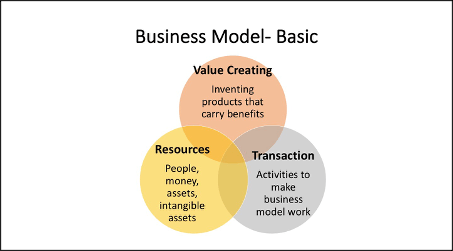
- Resources: are tangible and intangible assets necessary to run a business. Resources may include physical assets (e.g., machinery, furniture, or offices), human resources (e.g., management and employees), capital (i.e., monies), and unphysical assets (e.g., know-how, patent, trademark, intellectual rights, good-well, reputation, or experiences).
- Transactions: are activities necessary to create, deliver and capture values and include appointing staff, production, managing financials, storing, selling, and networking.
- Value creation: is about creating new solutions or products that customers want. Creating value involves observing people, understanding and identifying problems, developing solutions and prototypes, experimenting, and implementing. Not only do start-ups create value, but they also capture them by selling and monetising values.
Business model- Start-ups
This business model is designed for start-ups searching for the product-market fit and comprises three sets of activities to create, deliver, and capture values. The following is a brief description of this business model (Ash, 2012)2:
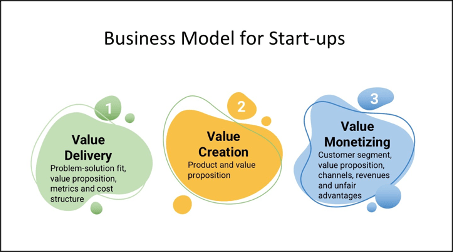
- Deliver value (or product development): comprises activities that start-ups make to deliver value to customers and include identification of the problem, solution, the key metrics to measure the activities, cost structure, and the value propositions.
- Create value: comprises activities that start-ups do to design and identify the value proposition of a new business, which explains why your business differs from other competitors and is worth buying its products or services.
- Monetise value (Market development): comprises the details related to selling and capturing values such as identification of the target customer segments, unique value proposition, channels (i.e., the path to customers), unfair advantage (i.e., how the new business and offer are protected), and revenue streams (e.g., revenue model, lifetime value, revenue targets, or gross margin).
Business model- Canvas
When start-ups successfully achieve problem-solution and product-market fit, they will be ready to draw the business model canvas showing their growth paths forward. The business model canvas is a fantastic tool for torching start-ups to grow business and comprises nine business blocks (Osterwalder and Pigneur, 2010)3:
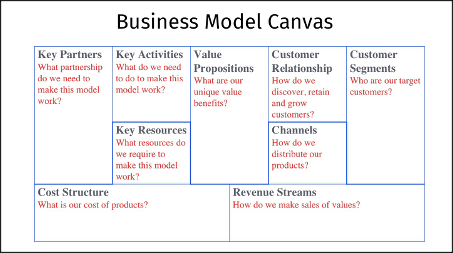
- Customer segments: define people and organisations an enterprise aims to reach and serve. To better satisfy customer needs, a company groups them into segments sharing similar needs, value perceptions, behaviours, interests, incentives, and fears.
- Value propositions: describe the bundle of products and services that create value for the customer segments. Value propositions are unique benefits that a company offers customer segments. The values may be quantitative (e.g., price, speed of service, or channels) or qualitative (e.g., easy to access, simple to use, design, or customer experience). A value proposition is worthy if it is a significant new, valuable, speciality, hard to copy and imitate, rare, and precious.
- Channels: describe how a company communicates with and reaches its customer segments to deliver value propositions. Distribution channels can be direct (e.g., sales forces, web sales, or own outlets) or indirect (e.g., partnerships, distributors, agents or wholesalers and retailers).
- Customer relationships: describe the relationships a company establishes with specific customer segments to make the business model work. Customer relationships may be driven by motivations like customer acquisition, customer retention, customer growing, or boosting sales.
- Revenue streams: represent the cash (sales or income) a company generates from each customer segment. Revenues are significant to making net earnings (i.e., revenues minus costs). There are several ways to generate revenue streams: asset sales, usage fees, subscription fees, renting, licensing, or advertising.
- Key resources: describe the most important assets required to make the business model work. Resources can be physical (e.g., machinery or offices), financial (e.g., money or funds, capital, loan or grants), intellectual (e.g., non-physical assets, IPO, copyright, logo, know-how, customer database), or human (e.g., skilful staff and management).
- Key activities: describe the most favourable activities a company must do to make its business model work. They can be the production of values, supply chain management, acquiring resources, reaching markets, maintaining customer relationships, or earning revenues.
- Key partnerships: describe the network of suppliers and partners that make the business model work, reduce risk, or gain resources.
- Cost structure: describe all costs required to operate a business model. Cost structures can be fixed, like office rent (i.e., when they remain unchanged despite the production change) or variable, like the cost of materials (i.e., when expenses change due to production levels). Costs are spending that companies make to get services or materials necessary to achieve missions and plans.
Assessment of business model
There are no specific criteria you can use to assess the effectiveness and reliability of your business model. I believe the best business model is the one that achieves the highest degrees of desirability, feasibility, viability and scalability. For this, I list below the criteria for your guidance to judge the desirability, feasibility, viability, and scalability levels of your business model:

Desirability test (Market test)
- Value propositions: can your business model make a solution product or service that carries new, valuable, speciality, difficult-to-copy and imitate, rare and precious value propositions?
- Creating a market: can your business model create a new market and secure a sufficient demand for your new products?
- Competition: How does the business model strengthen your positioning and competition? Does your business model increase the edge of your business over competitors?
- Customer development: how will your business model gain, retain and grow customers?
- Channels: does your business model invent new channels to deliver and capture values?
- Others: how does your business model get customers or third parties to create value for you for free?
Feasibility test (Technical test)
- Value creation: how possible can your business model create values and quality control? How likely can your business model make sellable products that carry these value propositions?
- Team or technology-intensive (resources): is your business model a technology-intensive model? Does it require special talent skills? How easily can you get sufficient funds for your business?
- Waste control: can your business model contribute to waste elimination?
- Partnership: does your business model create new ways to partner with supply chains that support the operation of the business?
- Activities: does your business model invent creative activities to reduce cost, increase quality, reduce waste, and reduce lead time to the market?
- Protection: How does your business model protect your unfair advantages from copying and imitating from competitors?
Viability test (Profitability test)
- Profitability: can your business model support profitability?
- Sustainability: does your business model contribute to social support and environmental protection?
- Switching costs: how easy or difficult is it for customers to switch to another company?
- Recurring revenues: is every sale a new effort needed to make and follow up?
- Earnings vs spending: are you earning revenues before you incur costs?
- Cost structure: is your cost structure substantially different, better, and more supportive than your competitors?
Scalability test (Growing test)
- Potential scalability: how does your business model support the scalability of your business?
- Grow customers: does your business model have strong attractions to grow customers?
- Growth facilities: how easily can you grow without facing roadblocks (e.g., assets, infrastructure, customer support, hiring)?
Business model innovation- Reach
To help readers create new ideas, develop and test solutions, and implement innovations, I have developed the Business Model Innovation- Reach. Reach’s business model comprises eight business elements: (1) customer segment, (2) customer-value fit, (3) commercializing, (4) activities, (5) resources, (6) partnership, (7) profitability, and (8) measurement. To better understand the Reach model, the model is divided into three groups of elements: first, marketing which comprises a customer segment; second, production, including activities, resources, and partnership; and third, market production comprising customer-value fit, commercialization, measurement, and profitability. This business model is a helpful tool for guiding innovators to manage innovation projects. Here is a brief description of model Reach’s elements (Al Dawood, 2022)4:

Step one: Identifying customer segment
Every business model begins by identifying the target customer segment, who are considered potential buyers of the model’s products. Identifying customers involve gathering information about who they are and how you can reach them. Customer segments share similar interests, demographics, value preferences, behaviors, and motivations. For example, the customer segment targeted by Swatch watches, a Swiss-origin brand founded in 1983, is upper-middle-class youth of all genders, aged between 15 and 35 years old, who prefer fashionable design, trendy, sporty, and affordable watches.
Customers can exist or not exist in the market; thus, innovators will create disruptive products to satisfy the non-existence segment or target existing customers by making incremental innovations (e.g., upgrading features and functions on existing products).
To create a new customer segment, innovators can use the blue-ocean strategy. Here is a brief description of the blue-ocean steps to develop markets as suggested by (Kim and Mauborgne, 2005)5:
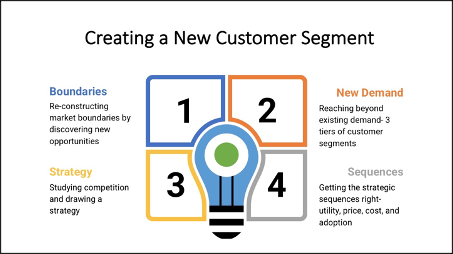
- Reconstructing the market boundaries: this involves looking at the existing industries and identifying opportunities, like looking across alternative industries (e.g., travelling by trains or cars), strategic groups within industries (e.g., Mercedes, BMW, and Jaguar), potential buyers, complementary offerings (e.g., car parking for theatre’s visitors and movie theatre services), functional and emotional appeal to buyers, and looking across time (e.g., thinking of the invention of digital mobiles since the early nineties, value extension and enhancement, and the trend of future development).
- Reaching beyond existing demand: current users of existing products are the ones who generate the existing demand, but there are other noncustomer groups that you may need to serve to extend boundaries, such as (1) consumers who only occasionally purchase an industry’s offering, (2) consumers who choose not to use your industry’s offering (for instance, some consumers avoid eating fast food due to health concerns), and (3) consumers who have never considered your industry’s offering due to factors such as price, distribution channels, or value perception.
- Drawing your strategy: once you conceptualize an innovation idea, it is time to draw a business model to create, deliver, and capture values similar to this underlying (Reach) model.
- Getting the strategic sequence right: this includes identifying the most critical factors for the strategy to be successful, which comprises utilities (or values), prices, costs, and adoption paths.
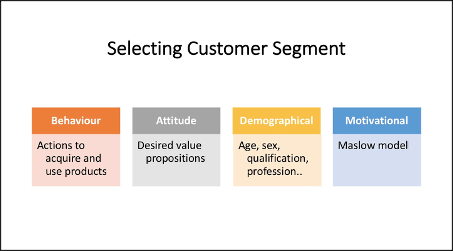
Meanwhile, choosing from the existing customer segments is far simpler than doing so for the non-existence segment, and innovators make incremental innovations (e.g., increasing the speed and storage capacity of computers) to meet the needs of the existing segments. Selecting the right customer segment for your sustainable innovations may involve breaking down the target market into sub-segments using segregation factors like motivational drivers (e.g., Maslow’s model of human motivation), behaviors (e.g., actions to acquire and use a product), attitude (e.g., desired value propositions), or demographical (e.g., age, sex, social status, or profession). The characteristics and traits of an appealing customer segment include easy communication and outreach, a sizeable enough to create sufficient demand, a higher potential to grow, and financial capability.
Step two: Reaching customer-value fit
Innovations involve creating new values that customers desire, and values can be new features, functions, benefits, or offerings to attract customers and lead markets. Customers can perceive value propositions as worthy if they are original, beneficial, and increase the customer experience. The customer-value fit is crucial for the success of any business model innovation because creating values is useless if they don’t meet the needs of the client.

To reach customer-value fit, you can observe customer segments to spot issues; map favourable values to customers (e.g., desired products, features, services, or benefits); analyse and identify customer profiles (e.g., incl. jobs to do, pains to encounter, and gains to desire); and then match the identified values with the customer profiles (Osterwalder, Pigneur, Bernarda, and Smith, 2014)6.
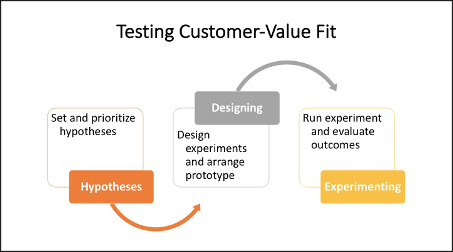
In testing the customer-value fit, innovators interview customers and collect their feedback on proposed solutions. Steps for customer-value testing involve setting hypotheses (on values and customer profiles), designing experiments, and experimenting (testing) to collect and analyse customers’ feedback. Customer-value fit is more concerned with the value tests- problem-solution and product-market fit.
Step three: Planning commercialisation of innovation
Our definition of innovation commercialisation involves three steps:
- Step 1- Innovation desirability: involves the recognition of new markets or demands for innovative products.
- Step 2- Innovation feasibility: involves the production and quality control of innovative products.
- Step 3- Innovation viability: involves selling and generating cash and profitability.

Market recognition of innovation (Research stage)
Recognising a new market for innovation involves many activities like observing, understanding customer segments, identifying a problem and ideating a solution, delivering problem-solution fit, developing a product prototype, testing the product-market fit, and scalability test.
Production and quality control of innovation (Implementation stage)
At this stage, the implementation processes of the innovation project begin and comprise activities like research and development to create or improve prototypes, technology development and licensing (in case of new technology), getting the value chain involved, product development and production, managing teams (recruitment, development and management) and resources, quality management (quality control and assurance), inventory management, risk management, and deploying an operating management system. This stage is called the implementation phase, converting conceptual ideas into reality and managing resources – time, energy, money, and above all, mobilising knowledge of different kinds – against a background of uncertainty (Joe and John, 2009)7.
Selling innovations and profitability (Operation stage)
By this stage, the company is ready to sell its innovative products and looking for customer development, the right set of distribution channels and selling the products for profit making. Monetising values and achieving the breakeven point and beyond are all the objectives of this commercialisation stage. A firm achieves those objectives by developing customers, choosing distribution channels, selling innovative products, and making profits.
Step four: Designing innovation activities
Innovation activities are critical efforts an organisation needs to perform to create, deliver, and capture innovative values. These activities describe the most important things a company must do to make the business model work involving, for instance, the production of values, supply chain management, acquiring resources, reaching markets and selling, maintaining customer relationships, and earning revenues.

What to innovate?
Innovation comes from three key sources, which are: (1) the organisation (e.g., improving the business processes, reducing costs, and creating a new system/business), (2) the market (e.g., satisfying unmet needs in markets), and (3) technology (i.e., making new inventions of technology, technological products and applications). These innovations can be disruptive (e.g., when they are original, valuable, special, rare, precious, and target new markets) or incremental (i.e., improvements to existing products and serving existing markets). Innovation typically involves four zones, as suggested by Geoffrey Moore in his book ‘Dealing with Darwin’:
- Product-leadership zone: includes breakthrough technologies, products, applications, and platforms.
- Customer intimacy zone: involves product extension and enhancement, customer experience, and marketing.
- Operational excellence zone: reveals process and efficiency innovations.
- Renewal zone: includes activities to achieve organic and external growth.
How to innovate?
The following are some approaches that provide you with broadly applicable techniques to help how to innovate:
- Full-spectrum innovation: an analytical approach to help you assess the company value chain to find innovation opportunities. This approach not only concentrates on customer needs but also increases the operational excellence of firms. The process of full-spectrum innovation involves evaluating the value streams of the firm and coming up with innovation opportunities as radical or incremental and related to products or processes. This method is conducted in an iterative cycle to pipeline the company with innovation opportunities and equip it with plans to gain.
- Design thinking: is recently reintroduced by IDEO, using customer-centric innovation techniques to uncover unmet needs. It is a systematic approach comprising four main steps: (1) Observation of people to inspire opportunities, (2) Understanding people’s specific needs and identifying the meaning, causes, patterns and stories related to those pains, (3) Ideation and Experimentation of new possibilities or solutions to the profiled pains, and finally, (4) Implementation of new ideas and rolling them out to the market.
- Jobs-to-be-done and consumption chain analysis: this is an alternative approach that focuses on uncovering the customer profile or job, pains, and gains and matches these findings with a developed value proposition that acts as a pain reliever and gain creator. This school of thought assumes that customers hire a product or service to perform a particular job or service. The customer job comprises details on the customer’s critical story to meet a specific need, timing, costing, functional, social and emotional objectives. According to this approach, innovators will understand the job requirements a customer is trying to make before inventing a solution.
- Blue ocean strategy: focuses on identifying unmet needs in markets (i.e., non-existing markets and customers) and developing solutions for them. The blue ocean thinking looks at the existing businesses and creates new products by expanding market boundaries (e.g., identifying opportunities resulting from studying alternative and complementary markets and reviewing the strategic groups of industries).
- The lean start-up method: an approach first applied by the Toyota company in the early eighties and turned out to be successful. This method comprises five value principles: value definition, value streams, market pull, value flow, and continual improvement. A lean start-up is a human-centred approach focusing on observing and understanding people, making innovative ideas, and building companies with higher growth. It involves creating ideas, developing a prototype, and quickly testing the problem-solution fit, product functionality, market acceptance, and ability to scale.
- Customer development model: Steve Blank’s book ‘The four steps to the epiphany’, explained how the customer model replaces the classical model of product development, as the latter model focuses on the delivery of the product, whilst the customer model aims at satisfying the needs of customers. A customer model is a customer-centric approach comprising four steps: customer discovery (problem-solution fit), customer validation (product-market fit), customer creation (growth test), and finally, company creation and growing customers.
- Open innovation model: Chesbrough’s book ‘Open Innovation’, argued the open innovation and its advantage over traditional closed innovation. Open innovation is when a firm accepts ideas, collaborations, and partnerships from inside and outside the company to develop innovations serving the company or the market.
- Traditional product development: is an iterative process aiming at assessing the company’s products or portfolio to improve their functionalities and features.
- The third way: develops a portfolio of complementary innovations around your products. This approach tries to help you make innovation around your products by answering four strategic questions: (1) what is your key product? (2) what is your value promise for your key products? (3) how will you innovate around your products? And (4) how will you create and deliver your innovations?
- Disruptive innovation: applies a new technology to create new products with a unique value proposition targeting an underserved segment of the current market and expanding up from there.
Innovation processes
Building business model innovation requires identifying procedures that enable teams to think, plan, experiment, create, and deliver values. Innovation involves three groups of processes, first, observation and identification of challenges; second, ideating, solution, prototyping, and experimentation; and third, implementation for rolling out innovations to market.
Step five: Identifying innovation resources
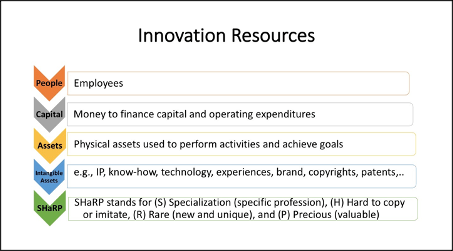
Innovation resources include human resources, capital, physical assets and non-physical assets (e.g., patents, know-how, goodwill, copyrights or valuable experience). Resources describe the most important assets required to make a business model work, and they can be owned or leased by the company or gained from the key partners (Osterwalder and Pigneur, 2010)8. A resource can be worthy if only it qualifies for the SHaRP rules: Specialisation (e.g., focus on a specific field of profession), Hard to copy and imitate, Rare (e.g., unique or new), and Precious (e.g., valuable). In designing a business model for innovation, you must determine the resources required to make the business model work. These resources include teams (e.g., structure, roles, job description, headcounts, duties, and costs), capital and funding (i.e., money to finance capital and operating expenses), technologies (e.g., machinery, tools, devices, and ERP), and information (e.g., research and development to understand the market and ideate).
Step six: Identifying innovation partnerships
In every innovation project, partnerships are critical to navigating value streams and networking with suppliers and partners to make the business model works. Innovation partnership describes the network of suppliers and partners that make the business model work, reduce risk, or gain resources (Osterwalder and Pigneur, 2010)9. Innovators will need partners to get values, technology, raw material and service supplies, distribution channels, finance, or professional support to turn innovation projects successful. Innovation partnership is about establishing necessary networks to leverage resources, capacities and knowledge. Start-ups must understand their partnership needs and collect enough information on the desired partnerships. Who are they? Why are they essential? And how are they connected to resources and activities? (Block and George, 2017)10. Potential partners to any business innovation can be customers (buyers and users), distribution channels (physical and online channels), marketing agencies (to manage advertising and promotional schemes), suppliers (to supply raw materials, technology, or machinery), recruiters (to provide talented employees), banks (financing), or utility providers ( to provide electricity, water, and gas). Partnerships can be formal, contracting with suppliers or strategic partners, and informal setups, like online networking.
Step seven: Planning innovation profitability
Innovation profitability tests the viability of business models and shows revenue surpluses over expenses and healthy cash flows. Profitability is net revenues after subtracting all expenses for a specific period (e.g., one year). Revenues are incomes a company makes from especially sales, and expenses are expenditures (e.g., salaries) and non-expenditures (e.g., depreciation and provisions) a company bears to get certain services associated with revenues for the period (e.g., one year). Cost structures for any company comprise fixed and variable expenses. The production level does not affect fixed expenses, such as depreciation or administration expenses; contrarily, variable costs are expenses like the cost of raw materials and production labour, which are associated with the production levels. Innovation profitability is a positive sign of successful projects resulting from higher demand over expenses.
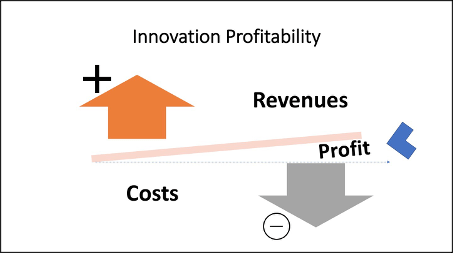
Osterwalder’s book, ‘The generation of the business model’ identified the revenue streams and cost structure of business models as per the following details (Osterwalder and Pigneur, 2010)11:
- Revenue streams: represents the cash or sales a company generates from each customer segment. Each revenue stream has different pricing mechanisms, such as fixed list prices, bargaining, auctioning, market-dependent, volume-dependent, or yield management. Revenues can be transactional, resulting from one-time customer payments, or recurring, resulting from ongoing deals. There are several ways to generate revenue streams, including asset or product sales, usage fees, subscription fees, renting, licensing, or advertising.
- Cost structure: describes all costs incurred to operate a business model. These costs cover the operational activities of a business model, including creating and delivering value, maintaining customer relationships, and generating revenues. Cost Structures comprise fixed costs, which remain unchanged despite the production change, and variable costs, which change due to the production levels.
- Influencers: all factors count in any business planning of profitability and include leadership, pricing strategy, revenue streams, cost structure, the breakeven point, efficiency, productivity, resources, technology, and more.
Step eight: Setting systems to measure innovation
In this section, innovators must set systems for measuring the progress and results of the business model innovation. There are four popular methods to measure innovation: (1) setting KPIs and metrics, (2) innovation accounting, (3) return on investment, and (4) a balanced scorecard.

- KPIs and metrics: This method is illustrated in Andrew’s book ‘Payback’ by setting key performance indicators (KPIs) and metrics for the company’s performances that cover inputs (e.g., resources), performance results (e.g., earned value, cost variance, and schedule variance), cash payback (i.e., cash generated from innovation), final results (e.g., sales generated from the innovations, number of patents, or revenue growth), and indirect benefits (e.g., gained knowledge, brand strength, and the organizational attractiveness) (Andrew and Sirkin, 2006)12.
- Innovation accounting: this method is conceptualized by Eric Ries in the book ‘The lean start-up’ (Ries, 2011)13, measuring the progress achieved by start-ups to deliver problem-solution fit, product-market fit, and scalability fit. These value fits depend on three things, which are customer profitability, the cost of acquiring new customers, and the repeat purchase rate of existing customers. Innovation accounting works in three steps: establishing baseline metrics, testing in the marketplace, and pivoting or accepting hypotheses.
- Return on investment (ROI): is a well-known term and means the project’s net return or net present value (NPV) (i.e., the project’s present value minus the investment costs) divided by the investment costs. Return on investment is a quantitative method to measure the benefits and costs of a project, and increasing ROI means the project is profitable and favourable for investment. This term is coined to measure innovations by Phillips in the book ‘The Value of Innovation’, introducing the ROI process model for measuring innovations (Phillips, J., and Phillips, P., 2018)14.
- The balanced scorecard: This approach translates an organisation’s mission and strategy into performance measures that provide the framework for the performance measurement system (Kaplan and Norton, 1996)15. A balanced scorecard guides companies to measure their performances in four fields: (1) financial, (2) marketing, (3) internal processes, and (4) learning and growing. The balanced system works by setting measures against the four business factors and frequently reviewing them with actual results. Examples for setting measures (or targets) include: financial (e.g., net income, return-on-capital, or economic value-added); customers (e.g., sales, growth of sales, or market share); internal business process (e.g., customer needs identification, operation, quality control, or distribution); and learning and growing (e.g., employee satisfaction, productivity, training, or staff turnover).
Business Model (Reach) and innovation leadership
The leadership of innovation is a practice to inspire and enable people, teams, organizations, and networks to create and innovate16.
Leaders can begin any change process by themselves, inspiring and implementing change and influencing teams and organizations to innovate. Behaviours are capabilities needed for conducting this process of change, including communication of vision and mission of initiatives, motivation of the teams, building networks, encouraging new initiatives and risk-taking, facilitating knowledge sharing, and inspiring co-creation.
At the team level, leaders tackle innovation by inspiring and enabling teams to create values. Innovation leaders promote innovation initiatives at the organizational level by fostering creativity-friendly culture, setting a vision, mission, and innovation strategy, creating a structure to process innovation, and developing people. Managing networks and partnerships are essential to creating innovation, as they leverage resources and promote sharing knowledge beyond organization walls to solve critical challenges and make innovation happens.
Having said that, the business model innovation (Reach) provides a set of capabilities for leaders to spot critical challenges, craft and test solutions, and evaluate impact. Here are the key capabilities the Reach model can facilitate for innovation leaders to create and innovate:
- Value creation: these are practices to observe people (or target customers), understand complications and issues for improvement, ideating of innovation (as radical or incremental), craft solutions and testing, and identify the value proposition of the innovation product.
- Value delivery: these are activities to identify the value proposition of an innovative product, set a structure to process innovation, including ideation and creation of innovations, plan resources (e.g., teams, capital, assets, and intangible assets), and cultivate networks and partnership to leverage resources and share knowledge.
- Value capturing: these are actions to distribute and sell values to beneficiaries (e.g., customers and users), including identifying target customers, matching value propositions with the customers’ profiles, estimating product cost, setting market and sales plans, selling values to customers, sustain and grow a business.
- Impact measuring: these are tools to measure the impact of creative innovation, including setting innovation targets and key performance indicators, quantitative financial tactics such as the return on investment rate, and the balanced scorecard (i.e., covering performance targets for the market, financials, operation efficiency, and learning and development).
In addition to the above capabilities, the Reach model can also bring value to innovation leadership, including:
- Inspiring teams and organizations to create innovation: having a clear strategy to create and innovate will cease the risk of failure and reluctance to inspire the teams and organization to take innovation initiatives on board. The reach model can inspire teams and organizations to create innovation by providing a clear framework for identifying new opportunities, focusing on customer needs, encouraging experimentation, promoting collaboration, and supporting strategic decision-making.
- Provide a road map to create values: the reach model is a roadmap to create, deliver, capture, and measure values. It provides a structure of processes, including identifying customers, customer-value fit, commercialization, activities, resources, etc, to create, deliver and capture values.
- Foster a culture of innovation within organizations: the culture of innovation is vital to inspire teams to think with creativity, take risks, co-work and share knowledge, accept failure as success, replace blaming with an encouraging attitude, and recruit and develop a talented team. The reach model fosters a culture of innovation by encouraging experimentation, providing a shared vision, focusing on customer needs, promoting collaboration, embracing failure, and adapting to changing market conditions.
- Balancing between risk-taking and potential failure: no gain without pain. Considering risks is the way to create and innovate. The Reach Model provides a framework to create values while considering risks by studying the market and customers, creating a customer-value match, and facilitating the delivery of values.
- Support leadership vision and strategy in creating a new business and values: leadership begins with a dream vision of change for a better place and then a strategy and action plan to realize innovation. The reach model can help leaders create a new business and values that align with their vision and strategy by providing a framework for decision-making, facilitating resource allocation, defining the customer value proposition, supporting innovation, and communicating the organization’s purpose.
- Enabling business agility and adaptability: business agility refers to the organization’s ability to satisfy the dynamic needs of customers, and adaptability involves adjustment to a new situation. In both cases, innovation will require such values to make it happen. The model that focuses on understanding and meeting the market needs to reach innovations, sets the floor for leaders to be flexible, creative, change forwarders, and customer-focus to make innovation.
- Improve learning and development: leadership learning and development on all business levels, including leaders, teams, organizations, and networks, are significant for discovering new ideas, crafting unique solutions and bringing creative values. The Reach Model fosters learning and development by better understanding the market and customers, creating a better customer-value match, managing resources, setting a structure of activities, and encouraging partnerships.
In the next section, I will show the results of a survey on the suitability and applicability of the business model innovation (Reach) to innovation leadership and value creation.
Business model innovation (Reach) in practice
To test the business model (Reach), I ran a questionnaire survey online with business leadership candidates and managed to collect (22) surveys. Here are the key results of the survey:
1. Background of respondents:
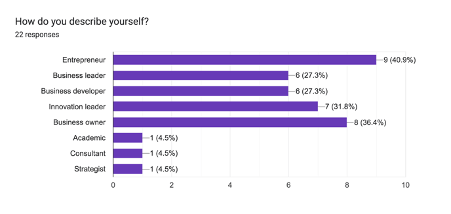
The survey indicates that respondents are mainly entrepreneurs, business owners, innovation leaders, business leaders, and business developers. This responding mix of candidates, as relevant and focused on the research subject, provides reasonable levels of trust, assurance and reliability on the survey outcomes.
2. Relevancy of Reach model to innovation leadership:
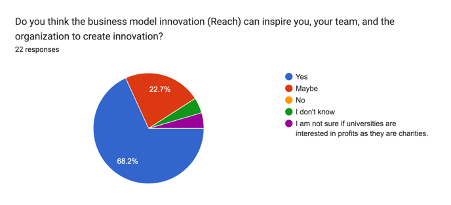
The survey confirms the relevancy and applicability of the reach model to inspire leaders, teams and organizations to create innovation. 68% of respondents have approved of the model’s suitability to support innovation leadership.
3. Reach model capabilities:

The survey results confirm that the reach model can bring many essential capabilities to businesses, including creating values (64%), supporting business growth (64%), measuring innovation impact (59%), delivering values to customers (55%), product development (50%), enabling networks (50%), along with selling values to customers (36%), customer development (36%), and increasing customer experience (36%).
4. Reach model values:

Similar to the model’s capabilities, the survey assures the model reach can bring significant value to innovation leadership, including inspiring teams and organizations (68%), providing a road map to create value (68%), fostering a culture of innovation (50%), supporting leadership vision and strategy of innovation (46%), enabling agility and adaptability (46%), improving learning and development (46%), along with balancing between risk-taking and potential failure (27%).
5. Respondents’ views on the applicability of the Reach model to solve challenges:
Question (5): In your opinion, how can the business model (Reach) help solve challenges in creating innovation? 22 responses
Respondents have thought the following challenges the reach model can be best suitable to tackle to create innovation:
- Problem-solving: Identifying issues and crafting innovative solutions.
- Market focus: fostering the market-focus culture.
- Check-list: using the model as a process system to check steps to innovation
- Value measurement: using the model to measure innovation
- Risk-taking: evaluating the risks and taking steps to change
- Decision-making: it helps to understand issues and make decisions.
- Resource management: identifying and using the resources available within a company
- Learning and development: a significant model to facilitate learning and development
- Team-inspiration: it inspires teams and organizations to create innovation
- Planning and prioritization: perceived as a tool to plan and prioritize innovation opportunities.
- Customer-value fit: the model doesn’t only study customer segments, but it also furnishes a way to ensure customer-value fitness.
- Innovation process: the model provides a clear set of processes to create innovation.
6. Respondents’ suggestions for improving the reach model:
Question (6): What do you suggest for improving the business model innovation (Reach)?
20 responses
Respondents have brought some bright ideas for improvement of the reach model, including:
- Referring to the target issue/problem
- Adding a new business block for product and service quality, research, risk, situational analysis, and competition.
- Make it a focus application instead of a generic one.
- Focus on GTM (Go-To-Market) as the sweet spot and practical to the world of innovation
- Simplifying the model by merging business blocks.
- Adding an operating manual describing the steps of filling the model.
- Automating the model.
- Adding a business block managing risks.
7. Overall suitability of the reach model to create innovation:

The survey has concluded with the suitability of the model to create innovation. (86%) of respondents confirm the suitability of the model, of which (59%) recommend the model with improvement and (27%) find the model sufficiently suitable.
Conclusion
The business model demonstrates how a start-up creates, delivers, and captures values. The business model (Reach), which I created, provides a practical framework to guide innovators to plan innovations, comprising eight business elements: (1) customer segment, (2) customer-value fit, (3) commercialising, (4) activities, (5) resources, (6) partnership, (7) profitability, and (8) measurement. Identifying and testing Reach’s model will help to reduce the risk of failure and facilitate easy progress toward successful innovations.
Conducted survey on testing the business model innovation (Reach) revealed the model’s suitability to innovation leaders. The reach model can bring capabilities to innovation leaders to innovate, including creating and delivering values, product and solution development, business growth, and innovation measurement. The reach model can also bring significant values or benefits to innovation leaders, including inspiring teams and organizations to create innovation, providing a roadmap to innovations, fostering a culture of innovation, supporting leadership vision and strategy, enabling agility and adaptability, and improving learning and development. Importantly, (84%) of respondents have confirmed the suitability of the reach model (either sufficiently or partially) to inspire teams and organizations to create innovation.
List of references
- Block, A. & George G. 2017. The business model, Pearson Business, United Kingdom.
- Maurya, Ash, 2012. Running lean, 2nd edition, O’Reilly, USA.
- Osterwalder, A. and Pigneur, Y., 2010. Business model generation, John Wiley & Sons, New Jersey.
- Al Dawood, M., 2022. Your guide to reach innovation, United Kingdom.
- Chan Kim, W., and Mauborgne, R., 2005. Blue ocean strategy, Harvard Business School Press, Boston, Massachusetts.
- Osterwalder, A., Pigneur, Y., Bernarda, G., and Smith, A., 2014. Value proposition design, Wiley, New Jersey.
- Joe Tidd and John Bessant, 2009. Managing innovation, Fourth Edition, John Wiley & Sons, Ltd, UK.
- Osterwalder, A. and Pigneur, Y., 2010. Business model generation, John Wiley & Sons, New Jersey.
- Osterwalder, A. and Pigneur, Y., 2010. Business model generation, John Wiley & Sons, New Jersey.
- Block, A. & George G. 2017. The business model, Pearson Business, United Kingdom.
- Osterwalder, A. and Pigneur, Y., 2010. Business model generation, John Wiley & Sons, New Jersey.
- Andrew, J. and Sirkin, H., 2006. Payback, Harvard Business School Press, Boston Massachusetts.
- Ries, E., 2011. The lean start-up, Crown Business New York.
- Phillips, J., and Phillips, P., 2018. The value of innovation, Wiley, NJ USA.
- Kaplan, R. and Norton, D., 1996. Balanced Scorecard, Harvard College, Boston Massachusetts.
- The definition of innovation leadership by the International Society for Professional Innovation Management- ISPIM.
Written by: Munther Abdulrahman
Enterprise expert, author, and educator
maldawood@growenterprise.co.uk
United Kingdom
 Grow Enterprise