
Concept
Design-driven thinking is a customer-centric approach popularised by the IDEO that aims at uncovering unmet needs. Design thinking involves observing people, inspiring opportunities, understanding their jobs, pains and gains, ideating solutions, developing prototypes for quick learning and validation, designing experimentations with new solutions, and implementing to roll out innovative solutions to the market.
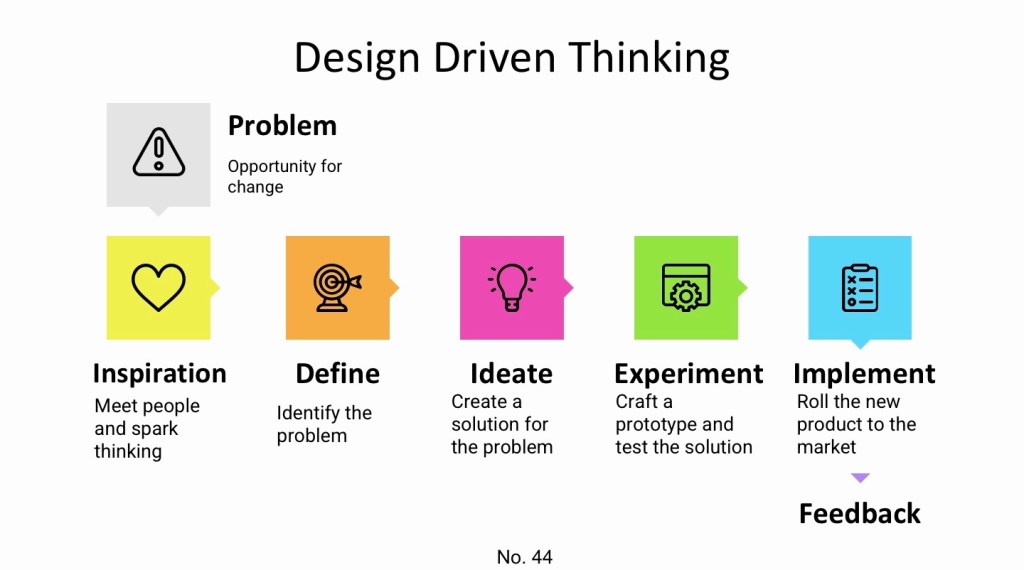
IDEO has also developed a human-centred design thinking that comprises steps:
- Hear: to understand people and identify issues, the design team observes, collects stories, and inspires people.
- Create: this is about translating what you heard from people into frameworks, opportunities, solutions, and prototypes.
- Deliver: this is about reaching and launching validated products in the market.
Background
The history of design thinking goes back to the 1940s, when Max Wertheimer wrote on ‘Productive thinking’ in 1945, ‘Creativity techniques’ in the 1950s, and design methods in the 1960s. Among the first writers about design thinking was John Arnold in ‘creative engineering’ in 1959 and L. Bruce Archer in ‘Systematic method for designers’ in 1965. Recently, design thinking was adapted for business by David Kelley, the founder of the design consultancy IDEO, in 1991 (Wikipedia).
How does it work?
Here’s an overview of the design thinking approach, as described by IDEO (Kelley and Kelly, 2013)1:
- Inspiration (Observe): Go out into the world, meet people, and proactively seek experiences that spark creative thinking. We find that connecting with the needs, desires, and motivations of people will help to inspire fresh ideas. Observing people’s behaviour in their natural context can help us better understand the factors at play and trigger new insights to fuel our innovation efforts.
- Synthesis (Understand): After your time in the field, the next step is to begin the complex challenge of “sense-making”. You need to recognise patterns, identify themes, and find meaning in all you’ve seen, gathered, and observed. We move from concrete observations and individual stories to more abstract truths that span across groups of people. We often organise our observation thoughts on an “empathy map” or create a matrix to categorise types of solutions. We reframe the problem and choose where to focus our energy.
- Ideation and experimentation (Solve): Next, we set off on an exploration of new possibilities. We generate countless ideas and consider many divergent options. The most promising ones are advanced in iterative rounds of rapid prototypes—early, rough representations of ideas, which are hard enough for people to react on. The key is to be quick and dirty—exploring a range of ideas without becoming too invested in only one. These experiential learning loops help to develop existing concepts and spur new ones. Based on feedback from end users and other stakeholders, we adapt, iterate, and pivot our way to human-centred, compelling, workable solutions.
- Implementation (Rollout): Before a new idea is rolled out, we refine the design and prepare a road map for the marketplace. The implementation phase can have many rounds. More and more companies in every industry are launching new products, services, or businesses to learn. They live in beta and quickly iterate through new in-market loops that further refine their offering.
- This post is sourced from my new book- Your Guide To Reach Innovation.
- For more information about the book: https://growenterprise.co.uk/your-guide-to-reach-innovation/
- To register in our newsletter: http://eepurl.com/ggcC29
Final note: the book- Your Guide To Reach Innovation, is an actionable guide to innovation from beginning to end. Enjoy reading the book, and I look forward to your reviews.
Author: Munther Al Dawood
maldawood@growenterprise.co.uk
References:
- Kelley, T. and Kelly D., 2013. Creative confidence, Crown Business, New York.
 Grow Enterprise