
Innovation activities are critical processes an organisation needs to perform to create, deliver, and capture innovative values. These activities describe the most important things a company must do to make the business model work involving, for instance, production of values, supply chain management, managing resources, reaching markets, maintaining customer relationships, and earning revenue.
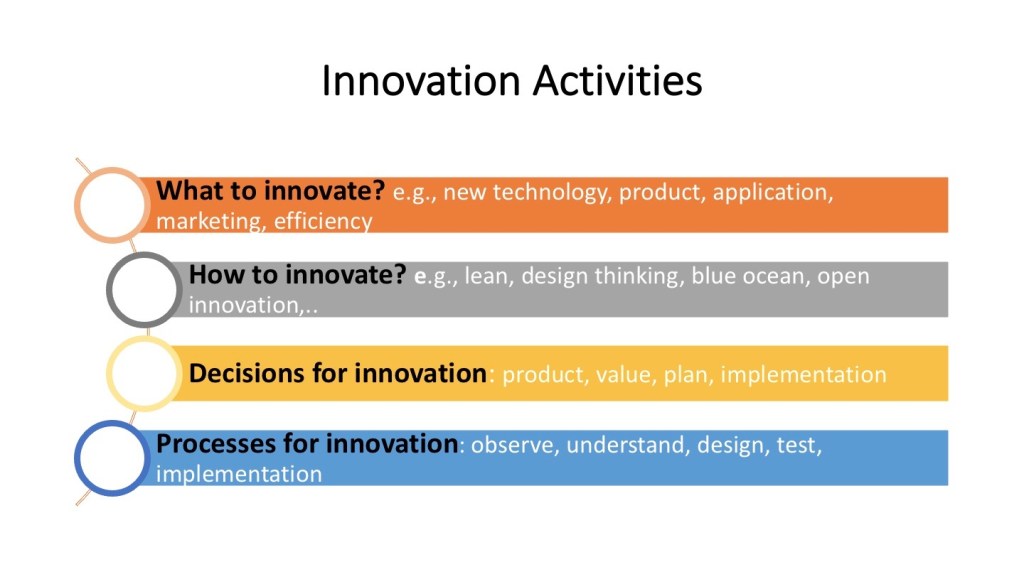
What to innovate?
Innovation comes from three key sources, which are the organisation (e.g., improving the business processes and reducing costs), the market (e.g., satisfying unmet needs in markets), and technology (i.e., making new inventions of technology products and applications). These innovations can be disruptive (e.g., novelty new, valuable, speciality, rare, precious, target underserved customers, and sell with lower prices) or incremental (i.e., improvements to existing products and serve existing markets and customers). Innovation typically involves four zones:
- Product-leadership zone: includes breakthrough technologies, products, applications, and platforms.
- Customer intimacy zone: involves product extension and enhancement, customer experience, and marketing.
- Operational excellence zone: reveals process and efficiency innovations
- Renewal zone: includes activities to achieve organic and external growth.
Here are some practical processes for creating, testing and implementing a business model innovation, inspired by Osterwalder’s ‘The business model generation’:
- For start-ups, business model innovation results from one of four objectives: (1) to satisfy existing but unanswered market needs, (2) to bring new technologies, products, or services to market, (3) to improve, disrupt, or transform an existing market with a better business model, or (4) to create an entirely new market.
- In enterprises, business-model innovation reflects the existing model and organisational structure. The effort usually has one of four motivations: (1) a crisis with the existing business model (sometimes a “near death” experience), (2) adjusting, improving, or defending the existing model to adapt to a changing environment, (3) bringing new technologies, products, or services to market, or (4) preparing for the future by exploring and testing new business models that might eventually replace existing ones.
- Mobilise- Setting the stage: prepare for a business model design, including (1) frame project objectives, (2) test preliminary business ideas, (3) plan, and (4) assemble a team.
- Understand- immersion: research and analysis elements needed for the business model design effort. Activities involved include (1) scanning the environment, (2) studying potential customers, (3) interviewing experts, (4) researching records (e.g., examples of failures and their causes), and (5) collecting ideas and opinions.
- Design- Inquiry: generate and test viable business model options, and select the best. Activities involved include (1) brainstorming, (2) prototyping, (3) testing, and (4) selection.
- Implement- execute: generate and test viable business model options, and select the best. Activities involved include: (1) communicate and involve, and (2) execute.
- Manage- evolution: Adapt and change the business model in response to market reaction. Activities involved include: (1) scan the environment, (2) continuously assess your business model, (3) rethink your model, (4) align business models throughout the enterprise, and (5) manage synergies or conflicts between models.
How to innovate?
The following are some approaches that provide you with broadly applicable techniques to help how to innovate:
- Full-spectrum innovation: an analytical approach to help you assess the company value chain to find innovation opportunities. This approach not only concentrates on customer needs but also increases the operational excellence of firms. The process of full-spectrum innovation involves evaluating the value streams of the firm and coming up with innovation opportunities as radical or incremental and related to products or processes. This method is conducted in an iterative cycle to pipeline the company with innovation opportunities and equip it with plans to gain.
- Design thinking: is recently reintroduced by IDEO, using customer-centric innovation techniques to uncover unmet needs. It is a systematic approach comprising four main steps: (1) Observation of people to inspire opportunities, (2) Understanding people’s specific needs and identifying the meaning, causes, patterns and stories related to those pains, (3) Ideation and Experimentation of new possibilities or solutions to the profiled pains, and finally, (4) Implementation of new ideas and rolling them out to the market.
- Jobs-to-be-done and consumption chain analysis: this is an alternative approach that focuses on uncovering the customer profile or job, pains, and gains and matches these findings with a developed value proposition that acts as pain relievers and gains creators. This school of thought assumes that customers hire a product or service to perform a particular job or service. Customer job comprises details on customer critical story to meet a specific need, timing, costing, functional, social and emotional objectives. According to this approach, innovators will understand the job requirements a customer is trying to make before inventing a solution.
- Blue ocean strategy: focuses on identifying unmet needs in markets (i.e., non-existing markets and customers) and developing solutions for them. The blue ocean thinking looks at the existing businesses and creates new products by expanding market boundaries (e.g., identifying opportunities resulting from studying alternative and complementary markets and reviewing the strategic groups of industries).
- The lean start-up method: an approach first applied by the Toyota company in the early eighties and turned out to be successful. This method comprises five value principles: value definition, value streams, market pull, value flow, and continual improvement. A lean start-up is a human-centred approach focusing on observing and understanding people, making innovative ideas, and building companies with higher growth. It involves creating ideas, developing a prototype, and quickly testing the problem-solution fit, product functionality, market acceptance, and ability to scale.
- Customer development model: Steve Blank’s book ‘The four steps to the epiphany’, explained how the customer model replaces the classical model of product development, as the latter model focuses on the delivery of the product, whilst the customer model aims at satisfying the needs of customers. A customer model is a customer-centric approach comprising four steps: customer discovery (problem-solution fit), customer validation (product-market fit), customer creation (growth test), and finally, company creation and growing customers.
- Open innovation model: Chesbrough’s book ‘Open Innovation’, argued the open innovation and its advantage over traditional closed innovation. Open innovation is when a firm accepts ideas, collaborations, and partnerships from inside and outside the company to develop innovations serving the company or the market.
- Traditional product development: is an iterative process aiming at assessing the company’s products or portfolio to improve their functionalities and features.
- The third way: develops a portfolio of complementary innovations around your products. This approach tries to help you make innovation around your products by answering four strategic questions: (1) what is your key product? (2) what is your value promise for your key products? (3) how will you innovate around your products? And (4) how will you create and deliver your innovations?
- Disruptive innovation: applies a new technology to create new products with a unique value proposition targeting an underserved segment of the current market and expanding up from there.
Decisions to innovate values
Innovators make critical decisions to create ideas and build companies. Like any business model, innovators need to create, deliver, and capture new values. During the journey of innovation discovery and realisation, entrepreneurs will make the following decisions:
- Decision 1- Product: what is the product or service you wish to make? It can be a radical or incremental innovation product. The critical success criteria for any product is that it carries a new value proposition that customers want.
- Decision 2- Value: what is your value promise for your developed product? A value proposition is radical if it satisfies unmet needs, creates markets, targets low-end underserved customers, is new, and is beneficiary to customers will create tremendous demand. A value proposition can also be around an incremental product or relate to creating or improving operational excellence.
- Decision 3- Innovation plans: What are your plans to create your innovative product? Innovation processes include creating new solutions, prototyping, experimentation, research, and iterative testing.
- Decision 4- Creating and delivering values: how will you create and deliver your innovations? This decision is related to implementation activities to realise innovation milestones and delivery to the market. Implementation activities include identifying the team, resources, and processes needed to make innovations and distribute them in the market.
- This post is sourced from my new book- Your Guide To Reach Innovation.
- For more information about the book: https://growenterprise.co.uk/your-guide-to-reach-innovation/
- To register in our newsletter: http://eepurl.com/ggcC29
Final note: the book- Your Guide To Reach Innovation, is an actionable guide to innovation from beginning to end. Enjoy reading the book, and I look forward to your reviews.
Author: Munther Al Dawood
maldawood@growenterprise.co.uk
Further readings:
- IDEO. Human-centred design toolkit, 2nd edition.
- Boston Consulting Group, 2006. Innovation Survey 2006, Business Week.
- Osterwalder, A. and Pigneur, Y., 2010. Business model generation, John Wiley & Sons, New Jersey.
- Moore, G., 2005. Dealing with Darwin, Penguin Group, New York.
- Chan Kim, W., and Mauborgne, R., 2005. Blue ocean strategy, Harvard business school press, Boston, Massachusetts.
- Ries, E., 2011. The lean start-up, Crown Business New York.
- Everett Rogers, 2003. Diffusion of innovations, fifth edition, Free Press, New York.
- Blank, S. 2013. The four steps to the epiphany, Wiley, New Jersey.
 Grow Enterprise