
Every innovation project aims to make novelty values accepted and adopted by potential segments. This article is inspired by Rogers’s ‘Theory of innovation of 1962 (Everett Rogers, 2003)1, highlighting steps to generate innovations, factors for innovation diffusion, and users’ processes to acquire and discontinue innovations.
How do you generate innovations?
Generating innovations means making novelty values that dominate the scene, do a job, relieve pains, or create gains customers desperate to have. And by this, innovation processes involve three stages (1) identification of problems, (2) research and development, and (3) implementation (incl. commercialization, diffusing, and adoption of innovations). Here is a brief description of the innovation processes:
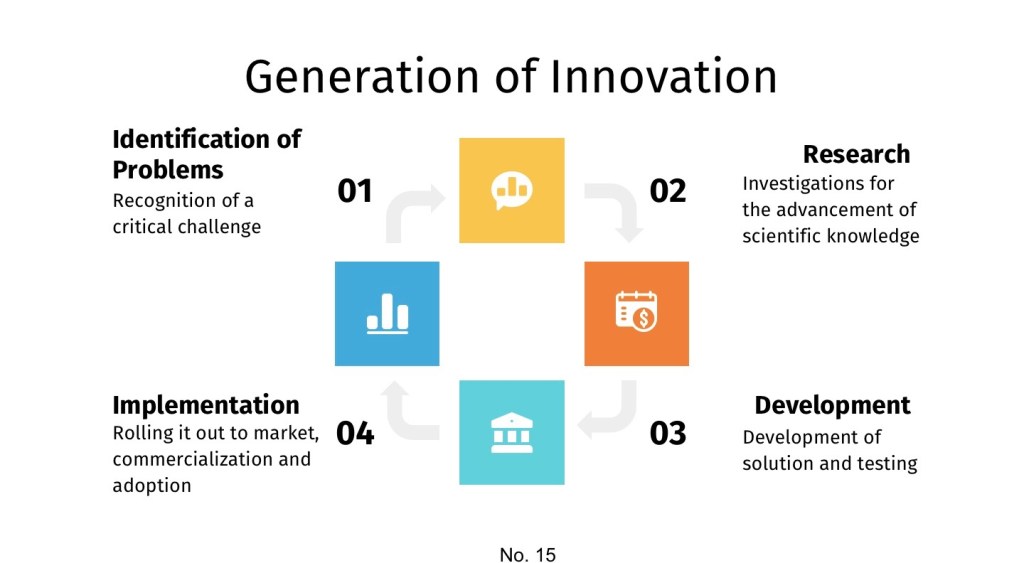
Identification of problems
This reveals recognition of challenges or unmet needs that may occur when a social (or people) perception of a problematic issue rises to a high priority which deserves research and investigation.
Research
Most technological innovations result from research which is an original investigation to advance scientific knowledge to solve practical problems. How does it work? Lead users like labs and universities develop innovations and concept prototypes, then convince a manufacturing company to produce and sell them.
Development
This is about crafting solutions and prototypes, and testing them in the marketplace. It is putting a new idea into a form expected to meet the needs of an audience of potential adopters.
Commercialization
It is defined as a collection of business activities to make and sell products and includes production, packaging, marketing, distribution, selling, and generating of cashflows from product innovation. Commercialisation is carried out mainly by private firms.
Diffusion
It is the last step in generating innovations and goes through the technology lifecycle comprising stages like an introduction to the market, growth, maturity, and decline. It describes how innovation is rolled out from production to the market and discontinued.
How do you diffuse innovations, and what are the factors involved?
Diffusion is the process of how members of a social system communicate innovation to each other over time, which results in innovation adoption and discontinuity. The diffusion of innovation involves four factors: innovation, channels, time, and social system.
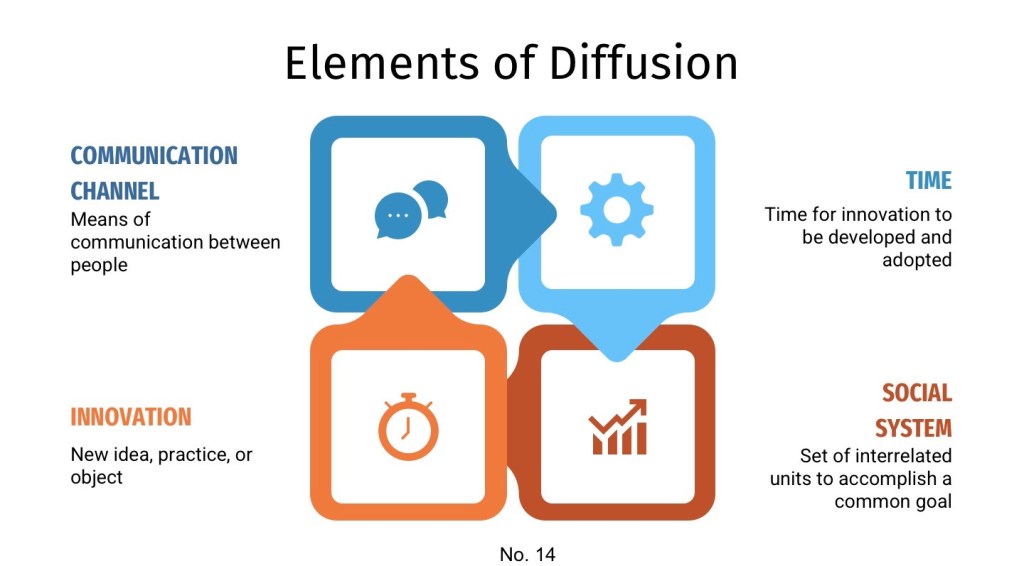
Innovation
Innovation is a new idea, practice, or object adopted by an individual or other social-system unit to solve a pressing problem. Innovation spaces comprise processes and products, sorted as incremental or radical. The innovation process aims at improving the efficiency of the organisation’s operation (e.g., reducing product costs). Innovation products are physical objects and services that carry values customers want. They are mainly technology products comprising two components: hardware (i.e., materials and physical objects embody technology) and software (i.e., the knowledge base to operate the hardware). The characteristics of any innovation include newness, desirable, valuable, and useable by the members of a social system. Innovations have the following five attributes:
- Relative advantage: is when innovation offers new values.
- Compatibility: is when innovation easily gets connected with other products.
- Complexity: this is the degree of complication or difficulty that requires users to have certain abilities to use innovative products or services.
- Trialability: this is when customers have the chance to try it before deciding on it.
- Observability: this is when innovation is easily observable by audiences.
Communication channels
Communication channels are ways to transmit messages from one individual to another. Innovations are diffused if only they are observed by users through communication channels. Mass media channels, like social media, are more effective in creating knowledge of innovations. But, interpersonal channels are more effective in forming and changing attitudes toward a new idea in influencing the decision to adopt or reject a new idea. Most individuals evaluate an innovation not based on scientific research by experts but through the subjective evaluations of near-peers who have adopted the innovation. These near peers thus serve as role models whose innovative behaviour is imitated by others in their system.
Time
Time is involved in the innovation-diffusion process, innovativeness, and an innovation rate of adoption. The innovation-decision process is how an individual passes from first knowledge of an innovation to forming an attitude toward it to a decision to adopt or reject, to implementation of the new idea, and confirmation of this decision. Innovativeness is the degree to which an individual or other unit of adoption is relatively earlier in adopting new ideas than other members of a social system. We specify five adopter categories and classifications of the members of a social system based on their innovativeness: (1) innovators, (2) early adopters, (3) early majority, (4) late majority, and (5) laggards. The rate of adoption is the relative speed to adopt innovation by members of a social system.
Social system
Social system is a set of interrelated units to accomplish a common goal. A system has a structure, defined as the patterned arrangements of units in a system, which gives stability and regularity to individual behaviour in a system. Social and communication activities drive the diffusion of innovations in the social system. One aspect of the social setup is norms that establish behaviour patterns for the members of a social system. Influences of any social system are typically opinion leadership and change agent. Opinion leadership is the degree to which an individual can informally influence other individuals’ attitudes or overt behaviour in the desired way with relative frequency. A change agent is an individual who attempts to influence clients’ innovation decisions in a direction that is deemed desirable by a change agency.
What are the adopters’ steps to use innovations?
Innovation-process decisions show how an individual acknowledges, persuades, adopts, or rejects an innovation. These processes comprise: (1) knowledge of innovation, (2) forming an attitude toward innovation, (3) deciding to adopt or reject innovation, (4) implementing/using the new idea, and (5) confirmation of this decision. The following is a brief description of the five steps to innovation-decision:

- Knowledge: is when the individual exposes an innovation and gains an understanding of how it functions.
- Persuasion: this is when the individual forms a favourable or unfavourable attitude toward the innovation.
- Decision: is when the individual engages in activities that lead to a choice to adopt or reject the innovation.
- Implementation: this is when the individual puts an innovation into use.
- Confirmation: this is when the individual seeks reinforcement for an innovation decision already made but may reverse the decision if exposed to conflicting messages about it.
- Re-invention: the degree to which a user in the process of innovation adoption makes changes to it. A higher degree of re-invention leads to a faster rate of innovation adoption and greater sustainability. Sustainability is the degree to which an innovation continues over time after a diffusion program ends.
- Discontinuance: a decision to reject an innovation after adopting it. Discontinuance decisions can be for replacement or disenchantment. In replacement discontinuance, an idea is rejected to adopt a better idea. Whereas disenchantment discontinuance is when refusing an idea because of performance dissatisfaction. Later adopters are more likely to discontinue innovations than earlier adopters.
- This post is sourced from my new book- Your Guide To Reach Innovation.
- For more information about the book: https://growenterprise.co.uk/your-guide-to-reach-innovation/
- To register in our newsletter: http://eepurl.com/ggcC29
Final note: the book- Your Guide To Reach Innovation, is an actionable guide to innovation from beginning to end. Enjoy reading the book, and I look forward to your reviews.
Author: Munther Al Dawood
maldawood@growenterprise.co.uk
References:
- Everett Rogers, 2003. Diffusion of innovations, fifth edition, Free Press, New York.
 Grow Enterprise