
In today’s business, firms and innovators apply open innovations to transform values. Yet, closed innovation suffers from a variety of erosions like expensive investments and higher risks which turns it less favourable for businesses to use in making innovations. In this article, I outline the open and closed innovations and how they work.
Open innovation
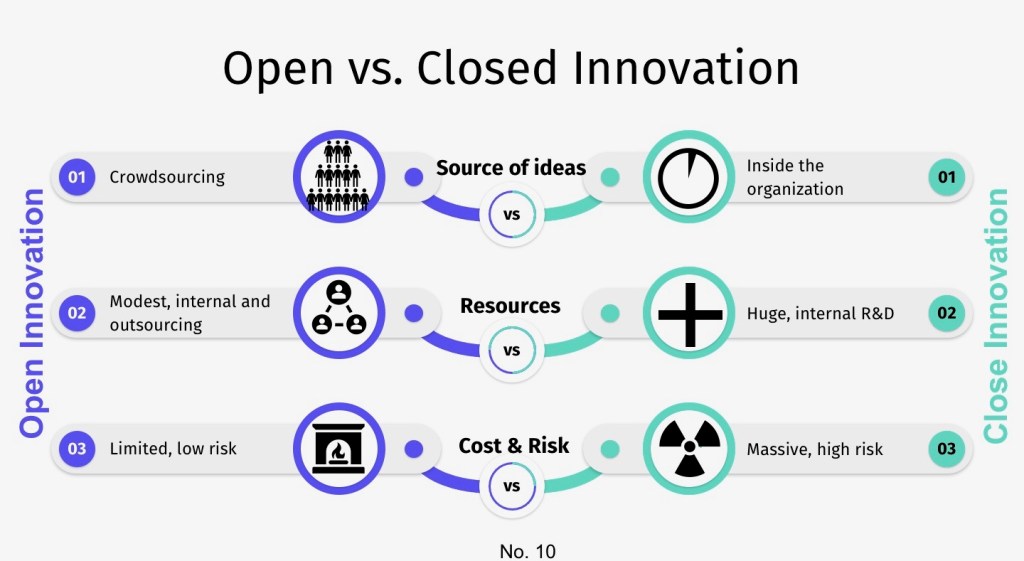
This type of innovation is crowdsourcing, whereby a corporation opens up and exchanges ideas with millions of outsiders (Jean-Mario Dru, 2015)1. In open innovation, ideas and resources come from inside and outside the firm and are used for increasing efficiency, improving products, or creating new markets. Open innovation is an alternative approach to making new ideas work and depends on creating ideas from inside and outside the organisation for developing a product or improving processes (Max McKeown, 2016)2. Open innovation means that valuable ideas and technologies can come from inside or outside the company; thus, this new approach has changed the logic for the centralised R&D silos and huge investments in the closed innovation paradigm (Chesbrough, 2003)3.
Close innovation
Close innovation is contrary to the open innovation method. It is when ideas come from inside the organisation and mainly from the research and development units before products are developed and challenged to the market (Max McKeown, 2016)4. Closed innovation is pursuing the discovery and commercial development of scientific knowledge within the underlying firm; moreover, the signs of closed innovations are the institution of the central research lab and internal product development (Chesbrough, 2003)5. Ideas can no longer be stored on the shelf because they will leak out to the broader environment. Close innovation suffers from several erosion factors like the risk of leaking ideas and long, expensive, and risky research and development processes. Thus, what previously was a closed, internal environment (where the firm had to create ideas to use them) has been transformed into an open environment (where the firm develops ideas for external and internal use, and the firm can access ideas from inside and outside as well) (Chesbrough, 2003)6.
How do open and closed innovations work?
In the old days, when companies used to be very much closed and secretive in doing business, this approach has changed to an open business model, engaging innovators with the external ecosystem and working with various value-chain suppliers to make innovations. For example, if we look into the platform innovation, we will find that most of the new products like mobiles, computers, and cars, are being produced by the contribution of the platform suppliers. Open innovation has changed the business games, where businesses used to make huge investments in creating and running research and development centres to develop new products. In open innovation, companies can make successful innovations by only having a commitment, powerful vision, bright ideas, and effective communication integrated with outsourced technologies and value chains. By this, open innovation, as opposed to closed innovations, requires fewer investments and lower risks to innovate valuable products.
- This post is sourced from my new book- Your Guide To Reach Innovation.
- For more information about the book: https://growenterprise.co.uk/your-guide-to-reach-innovation/
- To register in our newsletter: http://eepurl.com/ggcC29
Final note: the book- Your Guide To Reach Innovation, is an actionable guide to innovation from beginning to end. Enjoy reading the book, and I look forward to your reviews.
Author: Munther Al Dawood
maldawood@growenterprise.co.uk
References:
- Jean-Mario Dru, 2015. The new ways to new, WILEY, New Jersey.
- Max Mckeown, 2016. The innovation book, Pearson, UK.
- Chesbrough, H., 2003. Open Innovation, Harvard Business Review Press, Boston Massachusetts.
- Max Mckeown, 2016. The innovation book, Pearson, UK.
- Chesbrough, H., 2003. Open Innovation, Harvard Business Review Press, Boston Massachusetts.
- Chesbrough, H., 2003. Open Innovation, Harvard Business Review Press, Boston Massachusetts.
 Grow Enterprise