
The result of any innovation can be a new or improved product, process, or breakthrough technology. Yet, not every innovation output has the same level of novelty, as the latter depends on a different set of factors. In this article, I show the innovation outputs and the factors influencing the value of novelty.
Innovation outputs
Innovation processes aim at producing new or sustainable products, improving the efficiency of enterprise operations (e.g., reducing the cost of the product or reducing the lead time to the market), or creating a breakthrough technology or application serving new or existing markets. The success of any innovation is judged on the captured values it brings to the firms and customers. These benefits can be financial, like increasing profit or cash flows, or non-financial, such as growing customers and sales or controlling the markets. Here is the description of the typical innovation outputs:
Business-centred outputs: (Increasing efficiency; inventing new businesses)
These are process-innovation outputs, which are improvements in how an enterprise operates to increase efficiency or invent new business. The focus of innovation here is on the organisational operations to, for instance, reduce the product costs or reduce the lead time to the market, or eliminate waste. These outputs can be incremental (e.g., improvement to existing processes) or radical (e.g., inventing a new process or system). For example, incremental innovation is when upgrading equipment or digital technologies, and radical when creating a new system like the Toyota Production System.
Customer-centred outputs: (Improving customer experience; creating new market and customers)
These are product and customer-service innovation outputs, which are improvements made to existing products or creating new products or customer services. The focus here is either product or customer-experience offerings and can be radical or incremental. Windows Vista replacing XP, for instance, is incremental product innovation, while introducing the Toyota Prius – bringing a new concept of hybrid engines- is considered a radical innovation. Christensen’s book ‘The innovator’s solution’ defined sustaining innovations as ‘it targets the demand of the high-end customers with a better performance of an improved product, whilst disruptive innovation targets the low-end and non-consumption customers with better offerings. Radical products will disrupt the market by offering a more convenient product or a product with upgraded features at lower selling prices. It comprises low-end and new-market disruptive innovation’ (Christensen, 2003)1.
Breakthrough technology outputs: (Inventing new technologies and applications)
These are new technologies and applications developed by technologists (or so-called techies). According to Moore’s book ‘Dealing with Darwin’, techies invent and launch new technologies in the market, and then early adopters (or so-called visionaries) further develop these technologies and transform them into technology products, applications, and platforms that are more desirable to the market streams (Moore, 2005)2. The discovery of the internet and digital mobiles, for instance, is a breakthrough technology at the time of discovery. Technology development goes through different stages: inspiration, synthesising, research and development, ideation, prototyping and testing, and implementation. It’s obvious to mention the higher risk and enormous resources required to create and capture the values of new technologies.
Factors influencing the innovation outputs
In exploring different aspects of innovation, here are some factors influencing the value of the innovation outputs (Joe and John, 2009)3:
- Degree of novelty: whether the underlying innovation is incremental (i.e., improved) or radical (i.e., new).
- Platforms and families of innovations: this is a way of creating stretch and space around innovations. Car makers are increasingly moving to produce models, although apparently different in style, that uses common components and floor pans or chassis.
- Discontinuous innovation: innovation has a life cycle which explains the innovation span of progression and discontinuity. What happens when the rules of the business game change? Most of the time, innovation takes place within a game of rules, which are clearly understood, and involves players trying to innovate by doing what they have been doing (product, process, position, etc.) but better. Some manage this more effectively than others, but the ‘rules of the game’ are accepted and do not change. However, occasionally something happens which dislocates this framework and changes the rules.
- Level of innovation: whether it is a component or architecture innovation. Another important lens to view innovation opportunities is as components within larger systems. Innovation is about knowledge – creating new possibilities by combining different knowledge sets. These can be as knowledgeable about what is technically possible or what particular configuration would meet an articulated or latent need. Such knowledge may already exist in our experience, based on something we have seen or done before. Or it could result from a process of search – research into technologies, markets, competitor actions, etc. And it could be in explicit form, codified in a way that others can access it, discuss it, transfer it, etc. Or it can be in tacit form, known about but not actually put into words or formulae.
- Timing: this is about the innovation lifecycle. In the pioneering work on this theme, Abernathy and Utterback developed a model describing the pattern in three distinct phases. Stage (1) Fluid (functional product performance)- where the focus is on new technology and product innovation. Stage (2) Transitional (product variation or differentiation)- gradually, these experiments converge around what they call a ‘dominant design’ – something which sets up the game rules. Transitional innovation represents a convergence around the most popular solution to the emerging configuration. Stage (3) Specific (cost reduction)- activities move from radical concept development to more focused efforts geared around product differentiation and delivering it reliably, cheaply, with higher quality and extended functionality. Similarly, as argued in Rogers Everett’s ‘Diffusion of Innovations’ and Geoffrey Moore’s ‘ Crossing the Ghasm’ and ‘ Dealing with Darwins’, the innovation lifecycle goes through five stages (introduction, growth, maturity, decline, and discontinuance). And innovation categories are shaped differently in every life cycle accordingly. In the introduction and growth stages, product leadership zone like breakthrough technology, products, application and platforms is created and diffused by techies, early adopters and early majorities. While innovations in customer intimacy and operational excellence are projected in the late growing stage and maturity to sustain market shares.
- Type of innovation: whether innovation is in the introduction, growing or maturity stage? Is it a product or process? Is it open or closed innovation? Is it for increasing customer experience or improving operational excellence?
Attributes influencing the value of novelty
There are many attributes of the value of novelty, including:
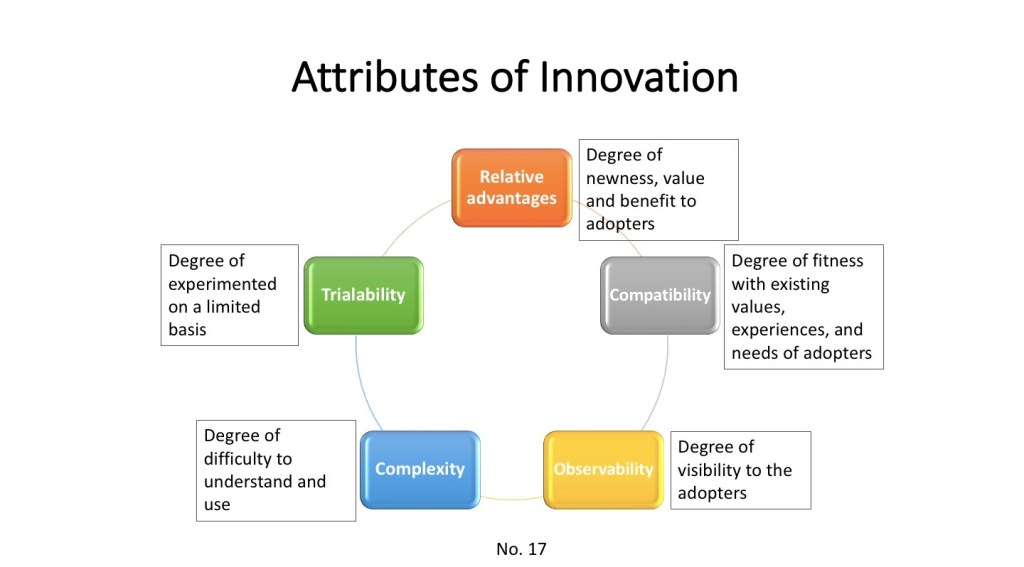
- Novelty new: e.g., disruptive innovations like digital mobile replacing landline phones come with a greater value than incremental and mature innovation.
- Value advantage: is the level of benefits around innovative products, processes or technologies. The value advantage is the benefits that make customers satisfied to achieve jobs, create gains, and relieve pains.
- Surprise significance: innovation value that comes with surprise or sudden values for the desired or unexpected values is more impactful on the demand created and customers’ decisions to use it.
- Specialization: e.g., does the underlying innovation have a specific field of speciality or generic in gain creating and pain relieving? Value is strongly connected with the degree of innovation speciality.
- Hard to copy: whether innovation is hard to copy or imitate by competitors and new players. Underlying innovation becomes more valuable if strongly protected from any copying or imitation.
- Rare: is whether the underlying innovation unique and hard to find or widely spread in the market. Rare innovation is more valuable than saturated ones.
- Precious: does innovation have the view of high value in the eyes of customers? Preciousness is usually measured by the price, benefits or wealth that brings to innovators. Precious innovation is more valuable than non-precious ones.
- Observability: is innovation easily observed by users or not? Novel innovations are more observable by users than less valuable innovations.
- Complexity: is innovation require special skills and abilities to be used? Simple and easy-to-use innovations are more valuable than complex ones.
- Compatibility: how easy is the underlying innovation to work with other devices and applications? Valuable innovation is more compatible with other things than average innovations.
- Trialability: can underlying innovation offer users a free and easy trial before buying? Trialability offers more assurance of value to the price to customers than innovation with less or no trialability before buying.
- This post is sourced from my new book- Your Guide To Reach Innovation.
- For more information about the book: https://growenterprise.co.uk/your-guide-to-reach-innovation/
- To register in our newsletter: http://eepurl.com/ggcC29
Final note: the book- Your Guide To Reach Innovation, is an actionable guide to innovation from beginning to end. Enjoy reading the book, and I look forward to your reviews.
Author: Munther Al Dawood
maldawood@growenterprise.co.uk
References:
- Christensen, C. 2003. The Innovator’s Solution, Harvard Business Review Press, Harvard.
- Moore, G., 2005. Dealing with Darwin, Penguin Group, New York.
- Joe Tidd and John Bessant, 2009. MANAGING INNOVATION, Fourth Edition, John Wiley & Sons, Ltd, UK.
 Grow Enterprise