
In organizing people, firms can better manage resources and improve efficiency by choosing the right-fit structure, roles and duties, appointing talented teams, delegating authorities, and enforcing flexible control. Whilst innovations require a structure that enables open innovation, gives special consideration to the innovation roles, and attracts gifted staff dreaming of a better life. In this article, I explain the strong relationship between structure and innovation and the factors influencing the structure system to enhance innovation.
What is the innovation structure?
The organisational structure is the way employees are set up to perform roles, and its importance lies in optimising human resources, easing decision-making, and controlling performances. There are two typical types of organisational structure, the tall and flat ones, and the key differences between these types are (1) the number of managerial levels (e.g., unit, section, department, or division), (2) decision-making processes (e.g., responsibilities and authorities evenly distributed between managerial levels), and (3) performance control (e.g., level of checking activities). The tall or vertical structure involves many management levels but fewer sections, strengthening control over performances and resulting in longer decision-making processes. A flat structure is opposite the tall one and includes fewer management levels and many sections, making it less controllable and easier for decision-making processes.
In an innovation context, the flat structure is more suitable for managing innovation activities in which the management sets independent sections and roles to carry out innovation duties within the organizational structure. Innovation roles, like innovation manager and officer, require different qualifications, experiences and duties than conventional roles. Innovating staffing requires flexible timing, collaborative efforts inside and outside the firm, accountability, system and facilities, and enabling leadership instead of controlling to aspire to divergent ideas and innovations.
How do you build a structure for innovation?
Building a structure that enables innovation involves the following steps:
- Decide on the innovation model: decide on the type of innovation between open or closed innovation, shaping the flow of ideas from inside or outside the firm. Open innovation involves collecting ideas from inside and outside the enterprise, while the opponent closed innovation focuses on ideas from the enterprise only.
- Strategy and system: developing an innovation strategy and operating system are necessary to manage innovation projects.
- Resources: setting up resources required to carry out the innovation strategy.
- Innovation roles: structuring a section responsible for managing innovation filled with aligned roles and duties to meet the innovation strategy.
- Management: give key decision-makers in the organization the knowledge, power, and incentives to direct the firm’s resources, especially when approaching market threats and opportunities.
- Integration: apply organisational integration, where both horizontal and vertical integration of skills and knowledge apply to foster cumulative learning.
- Development: allocate an adequate part of the budget for competence development to see cumulative innovation through.
- Structure attributes: decide on the innovation structure that meets the flexibility and agility needed to foster knowledge development through research processes, as well as experience, practice, and interaction between employees, clients, and suppliers. Such structure must allow interaction and communication between employees.
What are the influences of the innovation structure?
Influences that affect the innovation structure include:
- The vision and strategy to make innovation. Vision and strategy for innovation influence the type of structure (e.g., flat or tall), decision-making processes, and control of performances. For example, an innovation project preferably requires a flat structure with flexible decision-making and authority.
- The level of control desired: e.g., strong or weak. An innovation structure requires flexible control, a delegation of authorities to ease a decision-making process, and accountability.
- Cost of staff: a complex structure that requires more managerial levels and staff is more costly than a flat and simple structure.
- Nature of the business: business nature is influenced by many factors like the size and age of the firm, the types of products and services, and the field of industry. The business nature has a greater influence on the structure, the number of roles, staff qualification, decision-making process, and control.
- Easy flow of communication vertically and horizontally: innovation structure should facilitate effective communication to brainstorm, create ideas, and collaborate to deliver innovation projects.
- Level of collaboration: among staff and sections shape the organizational structure. For example, in the projected structure, the collaboration between teams is much stronger than it is in the ordinary structure.
- Kind of culture enforced in the organization: corporate culture is a sum of attributes, values, norms and assumptions on how the firm and staff work. Innovation requires a disciplined culture that encourages initiation and a mindset of change among staff.
- Delegation and decision-making process: a structure that enables delegation of authority and flexible decision-making must be a flat one, where managerial levels are limited and decentralized, and
- the flow of ideas within and from outside the firm. Open innovation that welcomes ideas and third-parties resources from outside and within the firm is more applicable for innovation than closed innovation, which depends on huge investments, facilities and silos of shelved research and ideas.
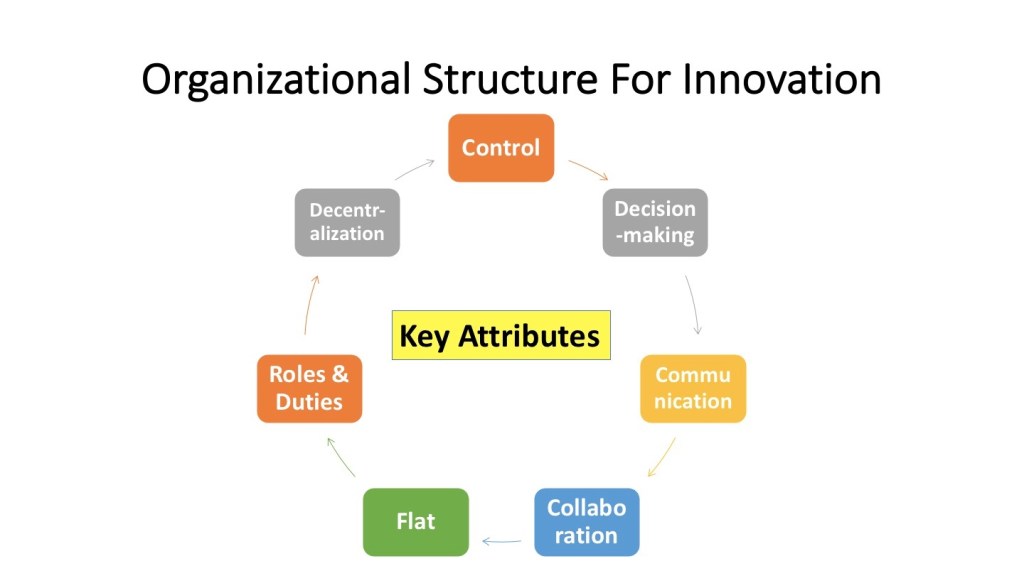
What are the key attributes of a structure for innovation?
Not only does innovation requires strategies, systems, resources, and leadership commitment, but also it needs flexible control and a decentralised decision-making approach. Here are some attributes of the innovation structure:
- Flat structure, with lower managerial levels, and made up of ad-hoc project teams.
- Low formalisation and management control.
- A horizontal specialisation of staff (i.e., when a staff possesses multi-skills other than speciality).
- Mutual adjustment and collaboration between teams with no formal coordination of roles.
- Decentralised decision-making for inter- and intra-team activities.
- Allow flexible, agile and communication activities to foster knowledge learning.
- Enable employee or team autonomy, accountability and creditability on innovation performances.
- Facilitate the innovation value chain phases of idea generation, conversion of ideas to products and services, and diffusion of the innovation throughout the company and its market.
- A simple organisational structure that has smaller and modular teams, is more cooperative and has a greater sense of purpose, which increases efficiency and creativity (Rajou, and Prabhu, 2015)26.
In Peter Drucker’s book ‘Innovation and Entrepreneurship (Drucker, 1985)27, the author outlined five key factors to be taken into consideration in a chosen structure for innovation:
- Companies create a structure that allows people to be entrepreneurial. It has to make sure that its rewards and incentives, compensation, personnel decisions, and policies all reward the right entrepreneurial behaviour and do not penalise it.
- Entrepreneurial projects are new and have to be organised separately from the old existing business.
- Innovation projects must be managed by independent roles, created only to manage innovation, with clearly defined job duties, and one with authority and prestige is fully accountable for it.
- People handling innovation projects must be paid differently than ordinary staff and rewarded incentives.
- Set accountability rules for innovation projects. Every innovation project will have a team leader who is countable for planning and achieving progressing results.
- This post is sourced from my new book- Your Guide To Reach Innovation.
- For more information about the book: https://growenterprise.co.uk/your-guide-to-reach-innovation/
- To register in our newsletter: http://eepurl.com/ggcC29
Final note: the book- Your Guide To Reach Innovation, is an actionable guide to innovation from beginning to end. Enjoy reading the book, and I look forward to your reviews.
Author: Munther Al Dawood
maldawood@growenterprise.co.uk
Reference:
 Grow Enterprise