
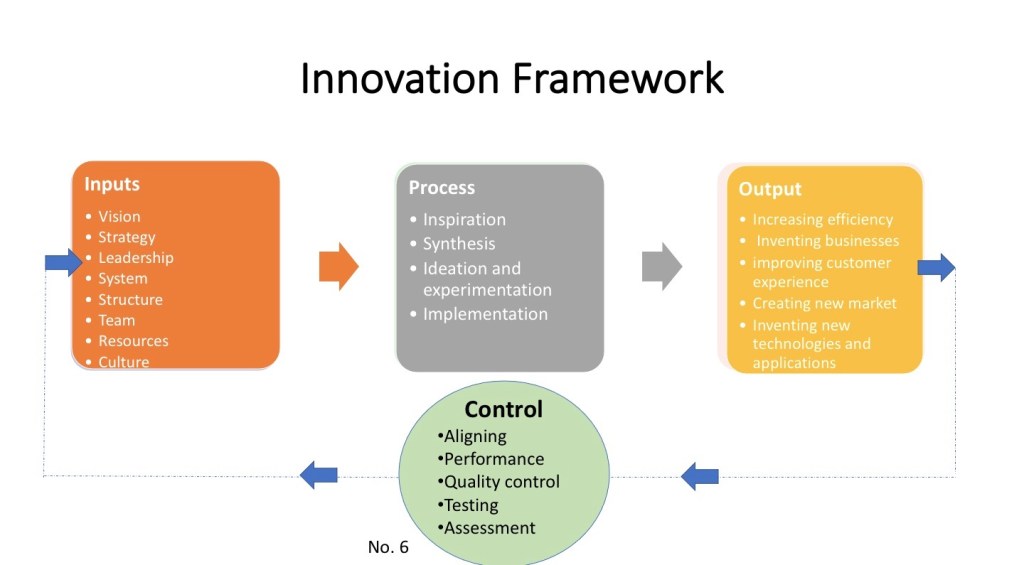
The innovation framework is the foundational structure showing what and how to create new ideas and transform valuable products. It’s an iterated and non-linear model that comprises inputs, processes, outputs, and control.
Innovation inputs
They include vision, strategy, leadership, operating manual, organisational structure, teams, resources and culture. Here is a brief description of innovation inputs:
- Vision: this is a dream about how a business or product will be in the future, and it is the starting point for any corporate strategy, objectives, KPIs, and metrics. Vision is a long journey that starts from where you are today to reach a better future.
- Strategy: documents how the company plans and delivers projects in the coming three to five years and comprises objectives, initiatives, projects, actions plan, resources and key performance indicators.
- Leadership: is a philosophy and approach that influences teams to invent ideas and products.
- Operating manual: shows why, what, how, by whom, and when questions about conducting activities in a firm. It covers all business activities in the company, including planning, sales and marketing, operations, human resources, finance, etc. The purpose of the operating manual is to standardise activities and achieve the company’s mission.
- Organizational structure: it is the way employees in an organisation are set up to perform roles, and its importance lies in optimising human resources, easing decision-making, and controlling performances.
- Teams: human resources are the main inputs to managing innovation. Talented, experienced and motivated teams are an asset to the organisation and essential to successful innovation.
- Resources: are valuable assets every company uses to conduct activities, meet strategic objectives and achieve missions. Resources comprise humans (e.g., staff and management), capital (i.e., money), physical assets (e.g., machines, buildings, offices), and intangible assets such as know-how, intellectual property, trademark or reputable brand.
- Disciplined culture: this is a set of values and norms exercised by a group of individuals in a business. These values are often implied and affect the ways employees behave and think in dealing with each other as teams and with outsiders. It is the key driver of the team to create new ideas and novel products.
Innovation processes
They are activities to generate ideas and develop innovation and include inspiration, synthesising, ideating, experimenting, and implementation. These processes are inspired by the IDEO’s design thinking approach (Kelley and Kelly, 2013)1 :
- Inspiration (Observe): It is about going out into the world and proactively seeking experiences that will spark creative thinking. Observing people’s behaviour in their natural context can help you better understand the factors at play and trigger new insights to fuel our innovation efforts.
- Synthesis (Understand): it’s about recognizing patterns, identifying themes, and finding meaning in all that you’ve seen, gathered, and observed. You reframe the problem and choose where to focus your energy forward. The key outcome of this process is to identify problems.
- Ideation and Experimentation (Solve): it’s generating countless ideas and considering many divergent (different) options. The most promising ones are advanced in iterative rounds of rapid prototypes—early, rough representations of ideas that are concrete enough for people to react to. These experiential learning loops help to develop existing concepts and spur new ones. Based on feedback from end users and other stakeholders, you adapt, iterate, and pivot workable solutions.
- Implementation (Rollout): Before a new idea is rolled out, you refine the design and prepare a road map for the marketplace. The implementation phase can have many rounds. This phase is where companies launch and commercialize their innovative products in the market.
Innovation outputs
They are grouped into three sets of outputs:
- Business-centred outputs: these are innovations related to the firm itself, aiming to increase efficiency (e.g., reduce the product cost or improve processes), and invent new industries or businesses (e.g., make new technology).
- Customer-centred outputs: these are innovations (e.g., new or improved products), focusing on satisfying customer needs and aiming to improve customer experience and create new markets.
- Technology-centred outputs: these are product leadership zone, including breakthrough technologies, new technology products, services, applications, and platforms).
Innovation control
It involves the following activities:
- Aligning activities: aligning innovation initiatives with strategic objectives.
- Reviewing performances: monitoring and controlling results.
- Quality planning: planning quality metrics, checks, resources, and processes.
- Quality control: auditing results in line with quality plans and managing changes.
- Quality assurance: setting quality plans, metrics, checklists, resources, and trained teams.
- Testing: testing desirability (problem-solution and product-market fits), feasibility, viability, and scalability.
- Assessment of innovation impact: measuring and evaluating innovation results; there are many ways to measure innovations, including setting targets, return on investment, and a balanced scorecard.
- This post is sourced from my new book- Your Guide To Reach Innovation.
- For more information about the book: https://growenterprise.co.uk/your-guide-to-reach-innovation/
- To register in our newsletter: http://eepurl.com/ggcC29
Final note: the book- Your Guide To Reach Innovation, is an actionable guide to innovation from beginning to end. Enjoy reading the book, and I look forward to your reviews.
Author: Munther Al Dawood
maldawood@growenterprise.co.uk
Reference:
- Kelley, T. and Kelly D., 2013. Creative confidence, Crown Business, New York.
 Grow Enterprise