
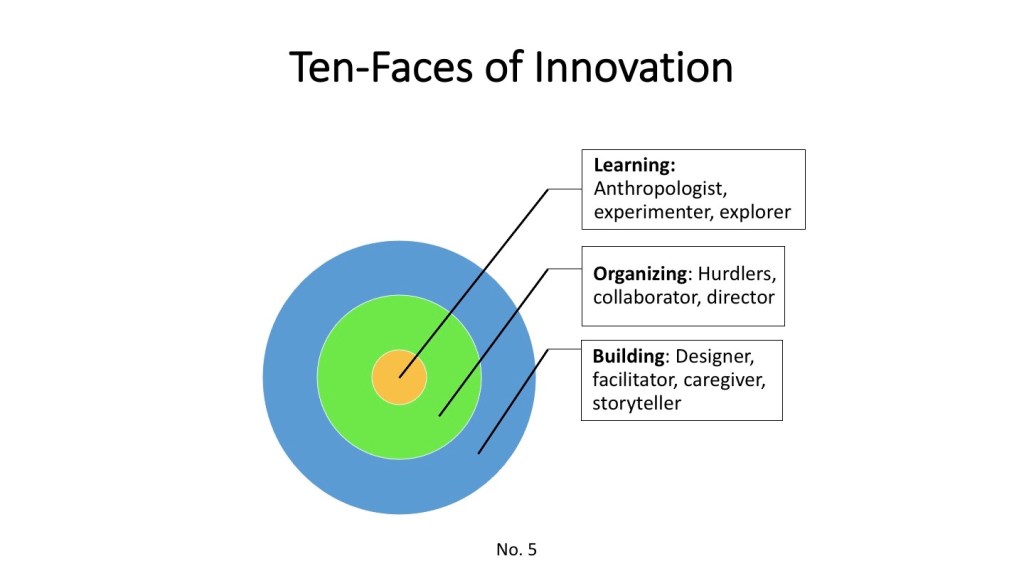
Kelley’s book ‘The ten faces of innovation’ (Kelley and Littman, 2005)1 described the ten innovation roles, especially in firms to manage innovation and grouped them into three sets of functions: (1) learning personas, (2) organising personas, and (3) building personas. The learning personas observe human behaviours, collect and synthesise insights, prototype new ideas and learn, and explore the external environment. The organising personas manage the firm’s activities to move ideas forward, involving problem-solving, collaboration, and leadership of teams to spark their creative talents. Last, the building personas apply insights from the learning roles and channel the empowerment from the organising functions to make innovation happen.
Learning personas
Individuals and organisations are always in need of gathering new information to expand their knowledge and grow, so the first three personas are learning roles.
- Anthropologist: brings new learning and insights into the organisation by observing human behaviour and developing a deep understanding of how people interact physically and emotionally with products, services, and spaces.
- Experimenter: prototypes and tests new ideas in the marketplace and learns by trial and error. The Experimenter takes calculated risks to achieve success through a state of “experimentation as implementation.”
- Cross-Pollinator: explores other industries and cultures and then translates those findings and revelations to fit the unique needs of your enterprise.
Organising personas
The next three personas are organising roles played by individuals who are aware of the process of how organisations move ideas forward.
- Hurdler: knows the path to innovation is strewn with obstacles and develops a knack for overcoming or outsmarting those roadblocks.
- Collaborator: helps bring eclectic groups together and often leads from the middle of the pack to create new combinations and multidisciplinary solutions.
- Director: not only gathers together a talented cast and crew but also helps to spark their creative talents.
Building personas
The four remaining personas are building roles that apply insights from the learning roles and channel the empowerment from the organising roles to make innovation happen.
- Experience architect: designs compelling experiences that go beyond mere functionality to connect at a deeper level with customers’ latent or expressed needs.
- Set designer: creates a stage where innovation team members can do their best work, transforming physical environments into powerful tools to influence behaviour and attitude.
- Caregiver: builds on the metaphor of a health care professional to deliver customer care in a manner that goes beyond mere service.
- Storyteller: builds both internal morale and external awareness through interesting narratives that communicate a fundamental human value or reinforce a specific cultural trait.
How do these personas help you create innovation?
The ten roles argued in Kelley’s book, ‘The ten faces of innovation’ described functions that organisations need to adhere to manage innovation. To begin with, it is learning, where you observe everything around you, like the market, people, legislation, economy, technology, societies, and environment, to discover opportunities. Then, identify problems, understand them more, and craft solutions and prototypes before you test them in the marketplace. After then is organizing, where you need organisational skills to perform business tasks like problem-solving, team collaboration, and leadership, to process discovered ideas and take them to the next levels. Last, it is building, where you need to take the discovered opportunities to the building stage; thus, you need capabilities to transform products or services, including architect design, resources, customer services, stories to tell about your invented innovation, and communication.
- This post is sourced from my new book- Your Guide To Reach Innovation.
- For more information about the book: https://growenterprise.co.uk/your-guide-to-reach-innovation/
- To register in our newsletter: http://eepurl.com/ggcC29
Final note: the book- Your Guide To Reach Innovation, is an actionable guide to innovation from beginning to end. Enjoy reading the book, and I look forward to your reviews.
Author: Munther Al Dawood
maldawood@growenterprise.co.uk
Reference:
- Kelley, T. and Littman, J., 2005. The ten faces of innovation, Random House.
 Grow Enterprise