
Managerial capabilities of innovation
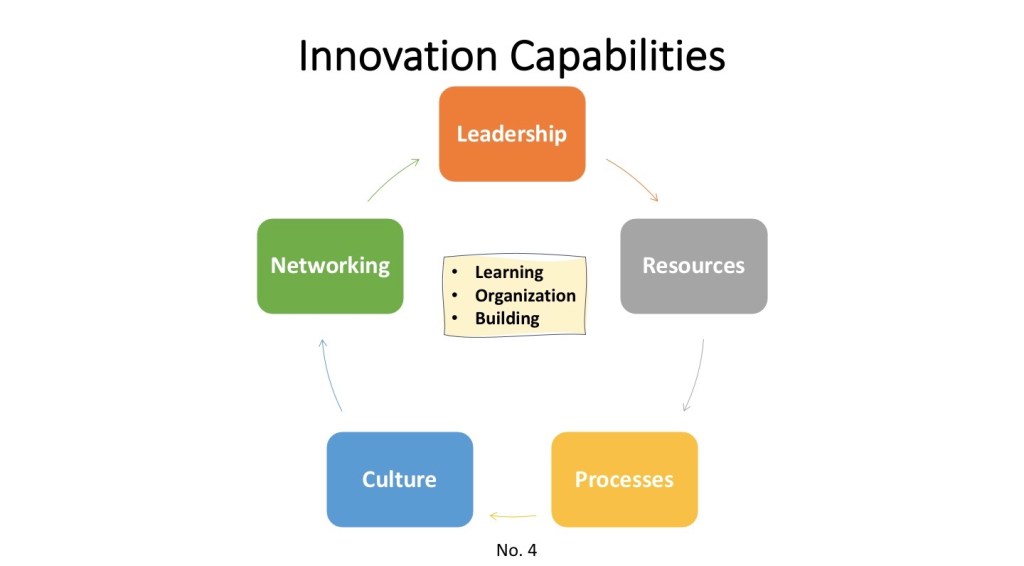
Innovation that involves insights, problem-solving, business modelling and testing, requires essential abilities to succeed. These capabilities include powerful vision, innovation strategy, resources, leadership, processes and supportive culture. According to Drucker’s book ‘Innovation and entrepreneurship’ (Drucker, 1985)1, a new venture to be successful will require a focus on the market to (1) create a new product for new customers, (2) make healthy cash flows, (3) build up a top management team, (4) restructure the organisation to include entrepreneur roles, and (5) the need for the outside advice to plan and decide on running their ventures.
Any start-up team that aims at nurturing disruptive innovation, will require three structural attributes: (1) scarce but secured resources, (2) independent authority, and (3) a personal stake in the outcome of their creation (Ries, 2011)2. Whilst any team with an incremental mindset, risk aversion, living with great complacency to their current situation, or experiencing a perception of unworthy new ideas, cannot make any disruptive ideas (Thiel, 2014)3.
In Christensen’s book, ‘the innovator’s solution’, Christensen mapped the road to getting organisations capable of disruptive growth as per the following requirements (Christensen, 2003)4:
- Enabling resources: include people, physical assets, intellectual properties and capital. Resources must be qualitatively and quantitatively sufficient to support plans for disruptive growth.
- Enabling processes: it is how work is performed and controlled. It should be clear, understood by concerned staff, communicated, controlled, and continually improved. It should encourage staff for new-growing targets.
- Enabling values (corporate culture): they are standards by which employees make prioritisation and decisions, make business and networking, and communicate with different stakeholders.
- Capability development: it is training staff to develop their capability for encouraging and performing disruptive innovation.
- Good hiring: organisation capability begins from the point of hiring competent staff. Good hiring that supports disruptive initiatives will have a powerful influence on the realisation of disruptive growth.
- Management of change: the management should have a clear vision, plans and tools to manage changes for the various disruptive inputs, such as resources, processes, values, staff hiring, funding, human development plans, planning, execution and implementation.
More precisely, innovation capabilities include four basic creativity skills (Hill, Brandeau, Truelove, and lineback, 2014)5:
- Creative Abrasion: it is the ability to create a marketplace of ideas, to generate, refine, and evolve a multitude of options through discourse, debate, and even conflict.
- Creative Agility: it is the organisational ability to test and refine ideas through quick experiments, reflection, and adjustment.
- Creative Resolution: it is the organisational ability to make integrative decisions that integrate disparate and even opposing ideas into a single superior solution.
Companies rarely possess all the capabilities they need to succeed in new businesses and environments. But, strategically, they can choose between four approaches for fast-forwarding the development of capabilities (Feser, C. 2012)6:
- First, firms can fast-build capabilities, engaging the front line in solving problems, having self-confident people in pivotal roles, and embedding changes in organisational processes can fast-forward the building of new capabilities.
- Second, firms can borrow capabilities. They can borrow them from other organisations by embarking on alliances, partnerships, or licensing agreements.
- Third, firms can buy capabilities. They can buy them by hiring new people, buying technologies, or gaining entire companies.
- Four, firms can keep spare capabilities in stock. By making venture investments and pursuing several smaller strategic moves in areas of potential interest, firms can hold many capabilities that are larger than those needed for implementing their current strategy.
Process-capabilities of innovation
The innovation process should be guided by the market focus and involves five basic activities (Carayannis, 2015)7:
- Creation of new ideas.
- Redesigning production processes to improve productivity and efficiency.
- Knowledge management to develop breakthrough technology and know-how.
- Product development documenting a detailed description of operations and product specifications.
- Redesign marketing processes to capture values.
In Furr and Dyer’s book ‘the innovator’s method’, they explained the steps needed to implement the innovator’s method, including (Furr and Dyer, 2014)8:
- Step 1. Insight: savour surprises. The Innovator’s DNA — questioning, observing, networking, and experimenting—to search broadly for insights about problems worth solving.
- Step 2. Problem: discover the job to be done. Rather than starting with solutions, start by exploring the customers’ needs or problems—the functional, social, and emotional job-to-be-done—to be sure you’re going after a problem worth solving.
- Step 3. Solution: prototype the minimum outstanding product. Instead of developing full-scale products, leverage theoretical and virtual prototypes of multiple solution dimensions. Then iterate on each solution to develop a minimum viable prototype and eventually a minimum outstanding product.
- Step 4. Business model: validate the go-to-market strategy. Once you’ve nailed the solution, you’re ready to validate the other components of the business model, including the pricing strategy, the customer acquisition strategy, and the cost structure strategy.
In addition, managing innovation activities involves diversified skills including (Joe and John, 2009)9:
- Recognising: searching the environment for technical and economic clues to trigger the process of change.
- Aligning: ensuring a good fit between the overall business strategy and the proposed change.
- Acquiring: transferring technology from various outside sources and connecting it to the relevant internal points in the organisation.
- Generating: having the ability to create some aspects of technology in-house – through R&D, internal engineering groups, etc.
- Choosing: exploring and selecting the most suitable response to the environmental triggers which fit the strategy and the internal resource base/external technology network.
- Executing: managing development projects for new products or processes from initial idea through to final launch.
- Learning: having the ability to evaluate and reflect upon the innovation process and identify lessons for improvement in the management routines.
- Developing the organisation: embedding effective routines in place, like vision, strategy, structures, processes, resources, leadership, creative-enabling culture, open innovation, etc.
The Innovator’s DNA of Clay Christensen argued capabilities for disruptive innovators, involving five discovery skills:
- Association: it’s thinking differently and creatively.
- Questioning: it’s asking questions to collect insights.
- Observing: it’s the observation of potential users or competitors or the improvement market.
- Experimenting: it’s experimental of a new idea for quick learning and testing.
- Networking: it’s creating dialogues with technical professionals to transform a new idea into value.
In summary, start-ups looking for innovation will need a variety of skills, some are managerial capabilities and others are process-enabling abilities. Managerial capabilities of innovation include vision, strategy, leadership, system, resources, networks, and disciplined culture. While, the rest of the abilities are process or operational skills like creative thinking, critical thinking, design thinking, discovering, problem-solving, ideating, experimenting, product development, value-creating, risk management, and implementation.
- This post is sourced from my new book- Your Guide To Reach Innovation.
- For more information about the book: https://growenterprise.co.uk/your-guide-to-reach-innovation/
- To register in our newsletter: http://eepurl.com/ggcC29
Final note: the book- Your Guide To Reach Innovation, is an actionable guide to innovation from beginning to end. Enjoy reading the book, and I look forward to your reviews.
Author: Munther Al Dawood
maldawood@growenterprise.co.uk
References:
- Peter Drucker, 1985. Innovation and Entrepreneurship- Practice and Principles, New York, Harper & Row Publishers.
- Ries, E., 2011. The lean start-up, Crown Business New York.
- Thiel, P., 2014. Zero to one, Crown Business, New York.
- Christensen, C. 2003. The Innovator’s Solution, Harvard Business School Press, Boston.
- Hill, L., Brandeau, G., Truelove, E., and Lineback, K., 2014. Collective genius, Harvard Business Review Press, Boston Massachusetts.
- Feser, C. 2012. Serial innovators, Wiley, NJ USA.
- Carayannis, E., Samara, E. And Bakouros, Yannis, 2015. Innovation and management- Theory, policy and practice: Innovation, technology, and knowledge management, Switzerland, Springer.
- Furr, N., and Dyer, J., 2014. The innovator’s method, Harvard Business School Publishing, Boston.
- Joe Tidd and John Bessant, 2009. MANAGING INNOVATION, Fourth Edition, John Wiley & Sons, Ltd, UK.
 Grow Enterprise