
Definition of innovation
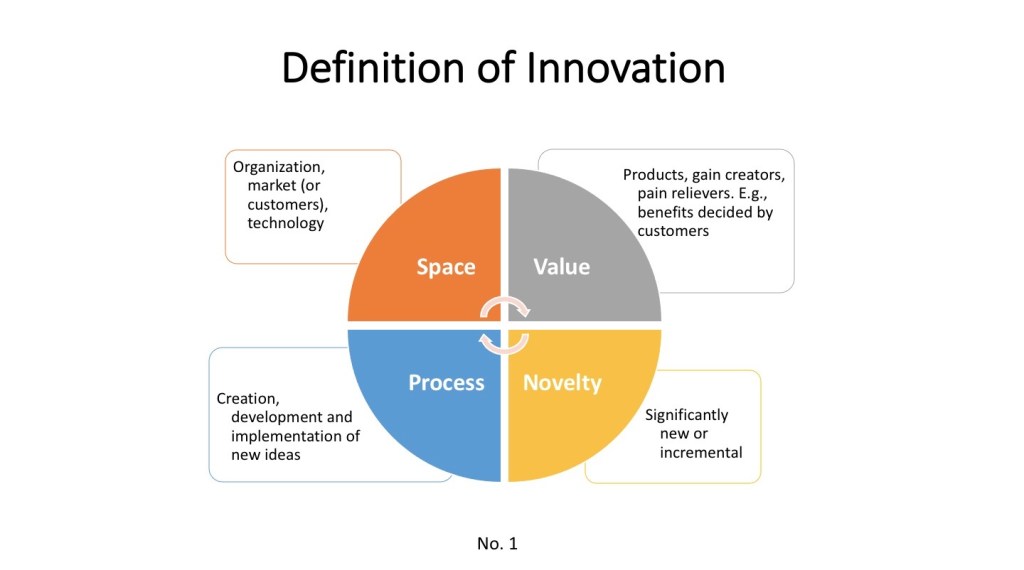
Innovation is a Latin term and means the introduction of something new to the existing world or improvement of resource productivity (Drucker 1985)1. Business innovation is concerned with the creation, development, and implementation of new ideas (Rogers, 2003)2. Innovation can be a new or significantly improved product or service, production or operating process, a way of attracting customers by enhancing their experience, an organisation’s practice, work design, human capital competency, or resources that add value (Phillips, 2018)3. Innovation is applicable creativity that makes new ideas useful. Creativity is the ability to come up with ideas or artefacts that are new, surprising and valuable, and it goes through four phases (1) preparation: it involves conscious attempts to solve the problem; (2) incubation: when fruitful novelties are initially generated; (3) illumination: the flash of insight; and (4) verification; involves testing the new problem-solving concept (Boden, 2004)4. According to Max’s book, ‘The innovation book’, creativity is about at least three different things: first, creativity is about thinking differently (creating novelty ideas); second, creativity is about feeling differently (seeing problems differently); and third, creativity is about focusing or committing differently (willpower and newness) (Max, 2016)5. Innovation is about seeing what others don’t see, and it requires problem-solving thinking, domain-specific creativity, and testing.
The Department for Business, Energy, and Industrial Strategy, in its UK innovation survey 2018-2020 issued in 2022, defined innovation as including any of the following activities:
- Introducing a new or significantly improved product (good or service) or process.
- Engagement in innovation projects is not yet complete, scaled back or abandoned.
- New and significantly improved forms of organisation, business structures or practices, and marketing concepts or strategies.
- Investment activities in areas such as internal research and development, training, and acquisition of external knowledge or machinery and equipment linked to innovation activities.
In summary, innovation is a process of creative thinking, development and implementation of novelty ideas that bring significant values to customers and comes as new or improved products or new processes to reduce cost and increase efficiency or enhancement the customer experience to sustain a business or breakthrough technology to lead the market.
Importance of innovation
Corporate growth and country prosperity are mainly driven by innovation. Innovation is always thought of as an engine of growth (Trott, 2017)8. Innovation can bring many benefits to businesses like market dominance, enhancing profitability and scalability, and to the countries by leading to the growth of the national economies.
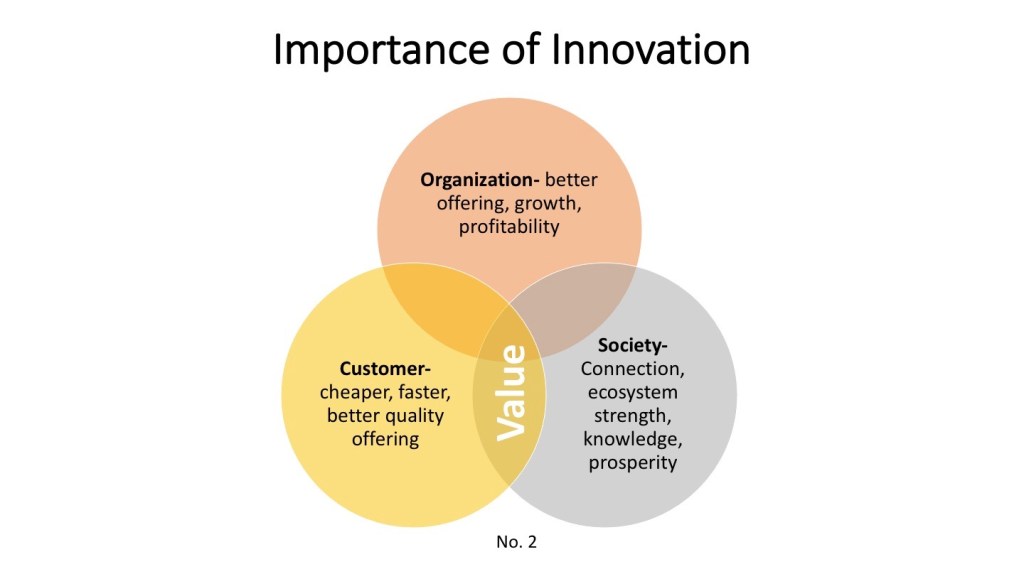
(Joe and John, 2009)9 listed the advantages of innovation as:
- Bring business success to innovative companies.
- Create and deliver novelty in companies’ offerings.
- Leading to the growth of national economies.
- The UK Office of Science and Innovation sees innovation as ‘the motor of the modern economy, turning ideas and knowledge into products and services’.
- An Australian government website (www.dest.gov.au/sectors/science_ innovation) puts the case equally strong: ‘Companies that do not invest in innovation put their future at risk. Their business is unlikely to prosper, and they are unlikely to compete if they do not seek innovative solutions to emerging problems.’
- According to Statistics Canada, innovation characterises successful SMEs as being innovative to achieve growth, gain market share and increase profit.
- Similarly, innovation enables better service – faster, cheaper, higher quality – has long been seen as a source of competitive edge.
Innovation also has indirect noncash benefits discussed by (Andrew and Sirkin, 2006)10 for knowledge acquisition, brand enhancement, ecosystem strength, and organisational vitality.
- Knowledge acquisition: it includes product-specific knowledge (i.e., knowledge used in creating a specific product), product-applicable knowledge (i.e., the knowledge that does not have an immediate product application but can apply to the company’s known product categories or business areas, greenfield knowledge (i.e., knowledge gained intending to open whole new business areas or product categories, and knowledge as a product (i.e., knowledge managed as an asset through sale or license to other companies).
- Brand enhancement: An association with innovation can enhance the reputation of a company, and its brand leads to brand benefits like premium prices, higher volume of sales, and greater acceptance by loyal customers.
- Ecosystem strength: Innovation can strengthen ecosystem relationships and improve cash payback in three ways: (1) preference (e.g., a company that focuses on innovation will have a preference over its competitors by ecosystem partners), (2) exclusivity (e.g., an innovative company may develop exclusive ecosystem relationships, and (3) standards (e.g., an innovative company may gain support for an industry-standard it favours).
- Organisational vitality: Sometimes, the underlying purpose of a particular invention, or even a program of innovation, is to benefit the people within the organisation. Innovation can breed two main organisational benefits—confidence and attractiveness. Confidence refers to the organization’s belief in the ability to pursue innovative projects. And attractiveness is when people with creative ideas and perspectives want to work in innovative companies.
Innovation is significant to individuals, businesses, and nations, giving helpful edges to innovators to stand out from the crowd. It influences the business value-added in the economy by, for instance, creating jobs, improving cash flows and profitability, increasing growth, and penetrating global markets, yet it supports the business ecosystem and encourages knowledge and technology development.
Sources and characteristics of innovation
Peter Drucker, in his legend book ‘Innovation and Entrepreneurship’ (Drucker, 1985)11, identified the sources of innovation within the enterprise, like:
- Unexpected opportunities or new values.
- Incongruity: a discrepancy between what is and what ought to be.
- Process need that aims at perfecting an existing process.
- Change in industry or market structure that brings out an opportunity to better satisfy customer needs and strengthen competitive positioning.
For example, recent developments in the automobile industry have shown innovative practices in engine power, speed, size, fuel economy, and autonomous vehicles.
Innovation is also caused by external sources to the enterprise, like:
- Demographic changes related to population, age structure, composition, employment, educational status and income lead to the creation of innovation opportunities.
- Changes in perception of societies toward, for instance, education, health or entertainment lead innovators to pick such changes in perception opportunities and build on them.
- New knowledge and technology can be applicable sources for innovation. For example, the invention of internet technology has opened the door to many digital giant businesses such as Google, Facebook, and Twitter.
- Innovation can be also a result of the system shocks such as the revolutionary way of online education or online banking.
- It can be a result of watching and imitating what others do.
- Changing in regulation and rules, or inspiration similar to what led Archimedes, for instance, to prove a range of geometrical theorems and mathematical discoveries (Joe and John, 2009)12.
Innovation can be originated from close sources to enterprises like research and development or employees, or open sources from suppliers, competitors or customers. In Thiel’s book ‘ Zero to one’, he identified the sources of the secrets of innovation as nature or people (Thiel, 2014)13.
The characteristics of significant innovation include:
- Value novelty: e.g., unique or newness.
- Value significance: e.g., solving a problem or creating gains or relieving pains.
- Value surprise: e.g., when customers or competitors don’t expect the significance of the innovative product.
- Value advantage: when an innovative product brings better value to customers than the preceded or competing products.
- Compatibility: when innovation is consistent with existing values, experiences and needs of potential users.
- Complexity: when an innovative product is difficult to understand or use.
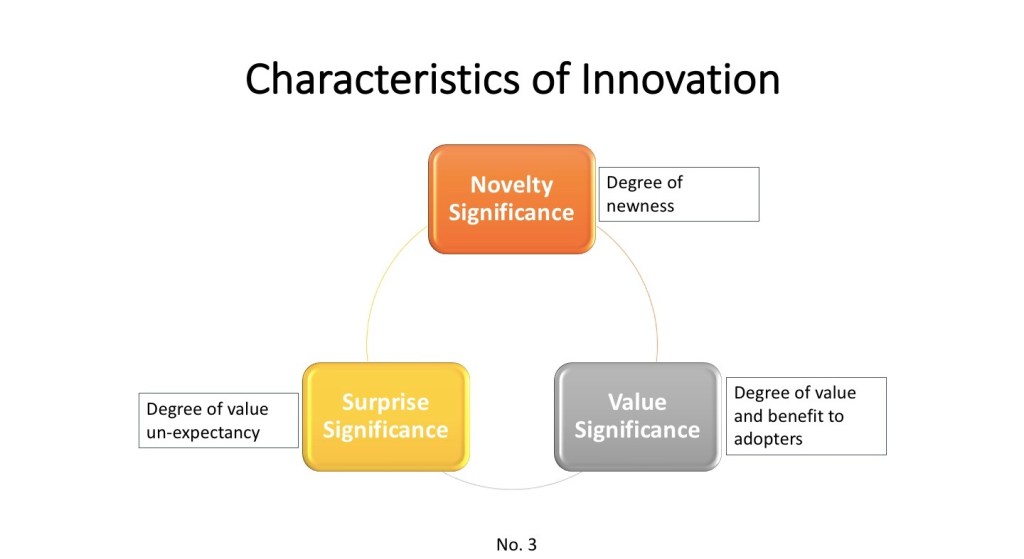
In summary, innovation begins with ideas generated from inside or outside the enterprise to bridge gaps in the market or inside an enterprise, and the motivation for innovation usually derives from the perception of people or businesses for change. Innovation, whether it is radical or incremental; a product or process has common characteristics: (1) novelty significance; (2) greater and unexpected values to solve problems; (3) desirable (i.e., a large number of customers want to buy it); (4) feasible (i.e., dominant value can be produced as a product or service acceptable to customers); (5) and viable (i.e., innovators can sell, make income, and sustain their businesses).
Final note: the book is an actionable guide to innovation from beginning to end. Enjoy reading the book, and I look forward to your reviews.
- This post is sourced from my new book- Your Guide To Reach Innovation
- For more information about the book: https://growenterprise.co.uk/your-guide-to-reach-innovation/
- To register in our newsletter: http://eepurl.com/ggcC29
Author: Munther Al Dawood
maldawood@growenterprise.co.uk
References:
- Peter Drucker, 1985. Innovation and Entrepreneurship- Practice and Principles, New York, Harper & Row Publishers.
- Everett Rogers, 2003. Diffusion of innovations, fifth edition, Free Press, New York.
- Phillips, J., and Phillips, P., 2018. The value of innovation, Wiley, NJ USA.
- Boden, M., 2004. The creative mind myths and mechanisms, Routledge, 2nd edition, New York.
- Max Mckeown, 2016. The innovation book, Pearson, UK.
- Joe Tidd and John Bessant, 2009. MANAGING INNOVATION, Fourth Edition, John Wiley & Sons, Ltd, UK.
- Keeley, L. 2013. Ten types of innovation, Willey, USA.
- Trott, P., 2017. Innovation management and new product development, 6th edition, Pearson, United Kingdom.
- Joe Tidd and John Bessant, 2009. MANAGING INNOVATION, Fourth Edition, John Wiley & Sons, Ltd, UK.
- Andrew, J. and Sirkin, H., 2006. Payback, Harvard Business School Press, Boston Massachusetts.
- Peter Drucker, 1985. Innovation and Entrepreneurship- Practice and Principles, New York, Harper & Row Publishers.
- Joe Tidd and John Bessant, 2009. MANAGING INNOVATION, Fourth Edition, John Wiley & Sons, Ltd, UK.
- Thiel, P., 2014. Zero to one, Crown Business, New York.
 Grow Enterprise